You type in a Pokémon you know, expecting to be wrong. Then one clue turns green. Another tells you the answer is lighter. Suddenly, that first guess feels useful. This is what makes Pokedle fun: you do not have to know the answer at once. You work toward it, one clue at a time.
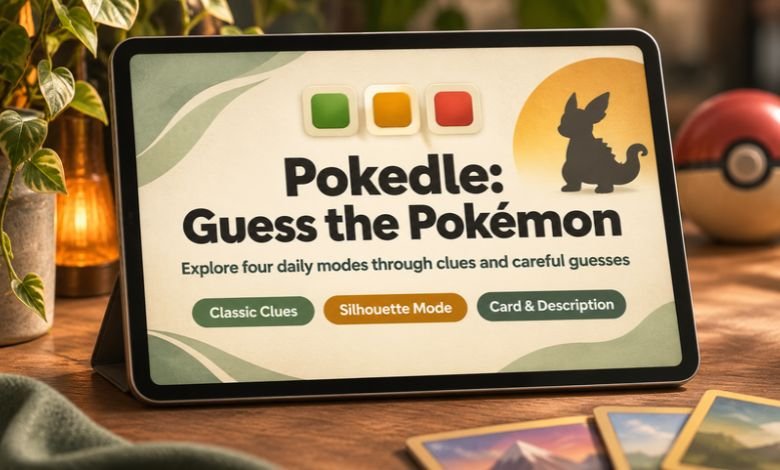
Pokedle is a browser-based guessing game with a new challenge to enjoy each day. At pokedle.net, you can play four modes: Classic, Silhouette, Card, and Description. Each one asks the same basic question which Pokémon is hidden? but gives you a different way to find out. If you like solving puzzles and recognizing Pokémon, there is plenty here to keep you thinking.
What Is Pokedle?
Pokedle is a daily game where you guess a mystery Pokémon. You enter a name or study the clue on the screen, depending on the mode you choose. A wrong answer does not simply end your attempt. It can give you information that makes your next guess better.
The idea is easy to understand, even if you have never played a daily guessing game before. You can start with a Pokémon you remember from a show, a game, or a trading card. From there, you look at what fits and what does not. Some days the answer may come to you quickly. On others, you might spend several guesses working out one stubborn detail.
How to Play Classic Mode
Classic Mode gives you the most information after each guess. Type a Pokémon name and the game compares it with the hidden answer. You will see results for its first and second types, habitat, color, evolution stage, height, and weight.
It can look like a lot to take in at first, so read the row slowly. Suppose you guess a Pokémon that shares a type with the answer but is too tall and too heavy. That tells you to look for a smaller Pokémon of the same type. If its color is wrong as well, you can rule out some otherwise tempting choices. Every box helps you make the list of possible answers a little shorter.
There is no need to find a perfect first guess. Choose a Pokémon whose features you know fairly well, then see what the game tells you. Your second guess can be more focused. By the third or fourth, you may have enough clues to make a strong choice instead of picking a name at random.
Reading Colors Without Getting Confused
The colored results in Pokedle show how each part of your guess compares with the answer. Green means a property matches. A partial-match color means your guess has something in common with the answer, but the match is not exact. An incorrect color means you should look for a different property.
The important thing is to read each result on its own. A green type does not mean your entire guess is close. Likewise, one wrong color does not make the rest of your clues useless. You might have the right evolution stage and the wrong habitat, or the right type and the wrong size. Look across the full row before deciding what to guess next.
If a partial result puzzles you, check the color guide on the game screen. It is better to spend a few seconds understanding that clue than to base your next three guesses on the wrong idea.
Let the Arrows Narrow Your Search
Numbers can be difficult to remember. Most players know that one Pokémon is tiny and another is enormous, but they may not know either one’s exact height or weight. That is why directional arrows are helpful. They point you toward a higher or lower value than the Pokémon you guessed.
Imagine that one guess is lighter than the answer and another is heavier. You now have a range to work with. Look for a Pokémon that falls between those two rather than trying to recall a precise weight. The same thinking can help with height and evolution stage. A few well-chosen guesses can turn a broad clue into a much smaller group of possibilities.
What Makes Silhouette Mode Different?
In Silhouette Mode, you identify a Pokémon from its dark outline. There are no trait boxes to study. You have to rely on what you can see: the head, body, ears, wings, horns, feet, or tail.
The first shape that comes to mind is not always the right one. Before entering a guess, look for one feature that makes the silhouette unusual. A curved tail may matter more than the size of the body. Long ears might look familiar, but do they point up or hang down? Small observations like these can save you from guessing several Pokémon that only look roughly alike.
If your first guess is wrong, take another look with fresh eyes. Once you have named a Pokémon in your head, it is easy to keep seeing that Pokémon in the shadow. Try describing the outline to yourself without using a name. That often reveals a detail you missed.
Playing Card and Description Modes
Card Mode shows a blurry Pokémon card. You may not be able to see the Pokémon clearly, but you can look for useful hints in the image. Notice where the main figure sits, whether there are large areas of color, and whether part of its pose stands out. One clue may be misleading on its own, so give the whole image a look before guessing.
Description Mode offers a Pokédex sentence. Here, careful reading matters more than quick recognition. Ask yourself what the sentence is actually describing. Is it talking about how the Pokémon looks, where it lives, or what it does? Then think of Pokémon that fit the full description.
These two modes can surprise you. A Pokémon you cannot identify from a blurry picture may feel obvious when described in words. Another may be easier to recognize from its shape than from anything you remember reading about it. Trying all the modes helps you find out which clues work best for you.
A Simple Way to Make Better Guesses
You do not need a complicated strategy to improve at Pokedle. After every Classic guess, pause and answer three questions: What do I know? What can I rule out? What do I still need to test? Those questions keep you from repeating the same kind of guess without learning anything new.
For instance, if you already know the answer’s type, another guess chosen only for that type will not help much. Pick one that also tests a possible color, size, or evolution stage. When two Pokémon seem equally likely, compare both with every clue you have collected. One may fit your favorite clue perfectly but fail several others.
You can make a short note if you need to. A few words such as “smaller,” “same type,” and “different color” are enough to keep your thoughts clear. The aim is not to turn a quick game into homework. It is simply to remember what your guesses have already taught you.
Enjoy the Puzzle at Your Own Pace
It is satisfying to solve a daily puzzle in only a few guesses, but that is not the only way to enjoy Pokedle. Sometimes a wrong guess is the moment the game becomes interesting. You notice a Pokémon’s traits, compare it with another, and eventually see why the answer fits.
You can also choose a mode to match your mood. Play Classic when you want to reason through clues. Try Silhouette or Card when you feel like testing your eyes. Open Description when you want a short reading puzzle. Even a few minutes of play can give you that pleasant “of course, it’s that one!” moment.
Conclusion
Pokedle turns a simple Pokémon guess into a small daily mystery. Its four modes give you different ways to solve that mystery, whether you enjoy comparing traits, studying images, or reading clues. Start with a name you know, pay attention to the feedback, and let each guess guide the next. Finding the answer feels even better when you can see how you got there.
Frequently Asked Questions
1. Is Pokedle free?
Yes, you can play the daily Pokedle puzzles in your browser for free.
2. Do I need to download an app?
No. You can open pokedle.net in a browser and choose a mode without downloading an app.
3. How many modes does Pokedle have?
Pokedle.net has four modes: Classic, Silhouette, Card, and Description. Each uses a different kind of clue.
4. What is the best mode for a beginner?
Classic is a good place to begin because every guess gives you several clues. If you enjoy recognizing shapes, you may prefer Silhouette.
5. What if I cannot guess the Pokémon?
Look back at every clue before trying another name. In Classic, use the colors and arrows together. In the other modes, focus on one clear detail you may have missed.
=