Writing an essay is not that difficult. You have a topic, you have something to say about it, and you have a word count that you need to fill. The transition from having an idea to creating a well-written, properly structured, academically rigorous essay is greater than the one between the lines and the page.
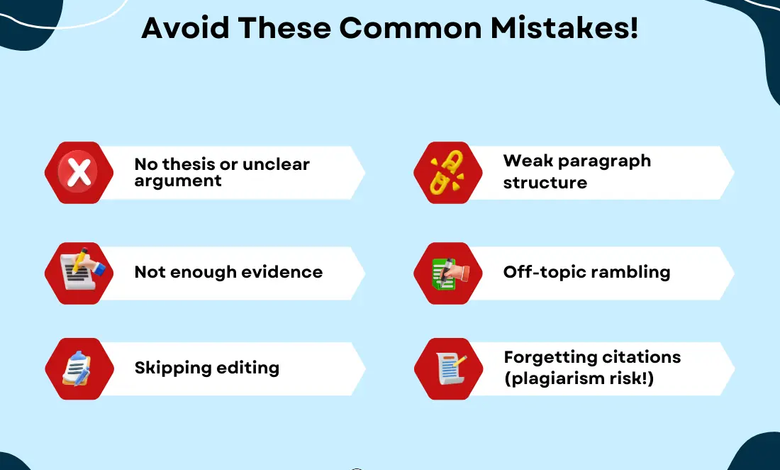
Fortunately, the majority of errors that occur in writing an essay are predictable. They repeat themselves – the same issues occur in student writing, across all subjects, academic levels and assignment types. One of the most practical ways for students to boost their essay grades now and continuously is to know what mistakes students make and why they make them, and how to avoid making them.
Here are the most common essay writing mistakes and the simple, actionable fixes for every single one.
Mistake 1 – Not Reading the Question Carefully Enough
This is the most common essay error of all levels of school and one of the most expensive. Most of the students read the essay question once, get an impression of what is being asked and begin to write based on that impression. As the impression is a little off, if they have missed one of the instruction words or if they have confused the particular angle that is being requested everything they produce answers a slightly different question from what is written on the page.
How to avoid it: Before writing a single word read the question at least twice. Find and underline all instruction words. Make a written statement of exactly what the question is asking you to do.
Mistake 2 – Starting to Write Without a Plan
A lot of students feel that planning is a waste of time as it gets in the way of them writing the essay itself. This is one of the most costly errors in essay writing, as it takes a lot of time and money and rarely saves any time at all. An essay that’s not organized is choppy, repetitive, and lacks a thesis statement or thematic development halfway through and needs a lot of editing to become coherent.
How to avoid it: Determine which arguments you will make and the sequence. Know where your essay is going before you start writing it. And if things go towards the wrong side, you can always pay for essay to achieve maximum results.
Mistake 3 – Describing Instead of Analyzing
This is the commentary that is used on the most number of student essays than any other — too descriptive, not enough analysis. Description is used to tell what something is or what has happened to it. Analysis provides your reader with meaning, why it is important, and its relevance to your argument.
How to avoid it: For every statement you make in your essay ask yourself, “So what? What is the significance of this? In what way does this assist my argument? If you can’t answer those questions your paragraph doesn’t analyses, it describes.
Mistake 4 – Using Weak or Unreliable Sources
The better your sources, the better your essay. An argument that falls apart when questioned because it is based on unreliable sources (websites, blogs, Wikipedia, unverified online content). Markers will sense in an instant if sources are not strong or if it does not support the confidence in your argument, no matter how well you are writing.
How to avoid it: Research peer-reviewed sources using your University Library database. Google Scholar is a free alternative, which brings up academic articles instead of regular web pages.
Mistake 5 – Poor Essay Structure
An essay that contains every idea a writer needs and presents them in the wrong order or interweaves the ideas between paragraphs without making clear links is not an effective communicator of the writer’s argument. Any marker who has to struggle to understand your logic is not impressed by your logic.
How to avoid it: At the end of writing each paragraph ask yourself – What is the one main point of this paragraph? If you can’t answer that in one sentence, then the paragraph is likely doing too much. Divide it up or cut away what is not in the picture.
Mistake 6 – Ignoring Referencing Until the Last Minute
One of the most heavily penalized aspects of the marking of academic essays, and one of the least considered aspects by students, is referencing. The bibliography can’t possibly be complete if you have to add citations at the end of the essay, and if you add citations at the end, chances are they aren’t formatted correctly. You will never get all the citations, properly formatted citations, and both cited and not cited sources, in the bibliography if you do your citations at the end of the essay.
How to avoid it: Find and quote references while composing. Use a source, cite it. As you write your essay, have a running reference list so that when you are done, your reference list is complete.
Don’t proofread your essay within several hours of when you have finished it – at least one day of rest should be allowed. Read your essay aloud instead of silently. Listen to it, and you’ll find the mistakes you can’t see. Read backwards from sentence to sentence for spelling mistakes.
Mistake 7 – Not Proofreading Before Submitting
One of the worst ways to lose marks is to have a poorly written essay, rife with grammatical errors, spelling mistakes, and poor sentence construction. Such mistakes give the impression that you are careless in your writing, and careless writing reduces even the strongest ideas to a lesser strength.
How to avoid it: Don’t proofread your essay within several hours of when you have finished it — at least one day of rest should be allowed. Read your essay aloud instead of silently listening to it and you’ll find the mistakes you can’t see. Read backwards from sentence to sentence for spelling mistakes.
The conclusion is a last-minute summary for many students and they are done before they reach the word count and submit. A weak conclusion not only feels anticlimactic, but it is also detrimental to the overall effectiveness of the essay because it diminishes the impact of a strong opening and thesis.
Mistake 8 – Writing a Weak Conclusion
Summarize the main ideas of your essay and make sure the reader is told why it is important and proven. Conclude the essay, reminding the reader, explicitly and persuasively, of the main ideas and why they are significant. Answer the question explicitly.
How to avoid it: Write your conclusion as if the reader has just finished your essay and needs to be reminded clearly and compellingly of what it proved and why that matters. And if you’re wondering, ‘can I pay someone to do my assignment UK’ then that option is also available on the table.
Final Thoughts
Carefully read the question and use credible sources. Present an argument that is well-organized. Use references as you go. Proofread properly. Conclude with a conclusion, and not an “oh, well, that’s the end of the lesson. End with a conclusion and not an “oh, well, that’s the end of the lesson.
When implemented regularly, these eight fixes will make your essays noticeably better, not after any length of time but immediately!