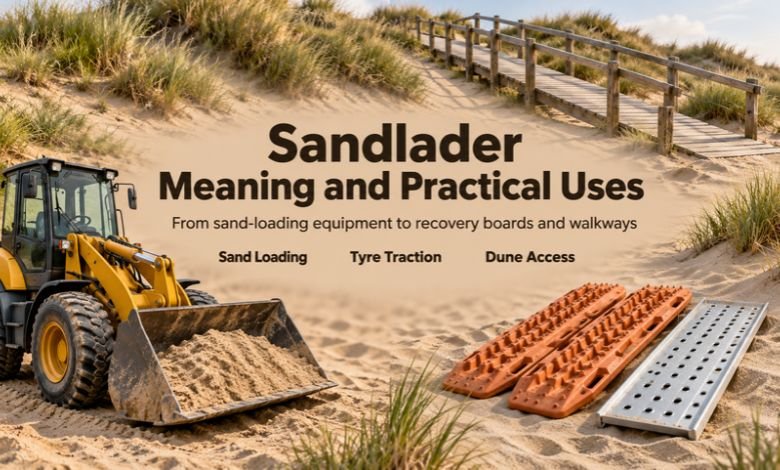
Search for Sandlader, and you might find a small toy with a scoop, a machine working beside a pile of sand or a pair of boards attached to an off-road vehicle. Those results can seem unrelated, especially when you only want a simple explanation.
The confusion comes partly from language. Sandlader is a German compound that can be read as “sand loader”. The similar English phrase sand ladder describes something else: equipment that helps vehicles or people move across sandy ground.
Understanding that difference makes the topic much clearer. Here is a closer look at where the word appears, what the equipment does and which details matter when reading a product description.
What Does Sandlader Actually Mean?
The German word combines Sand, meaning sand, with Lader, meaning loader. Its basic meaning points towards something that loads sand. However, the name alone does not tell you whether the subject is a working machine or a children’s product.
GOWI, for example, uses Sandlader as the name of a toy in its sand-play collection. That is a clear example of the word appearing in an ordinary product range.
A sand ladder used for vehicle recovery belongs to a different category. German equipment suppliers commonly describe metal recovery panels as Sandbleche. Although the words may appear together in search results, a sand loader and a sand ladder do different jobs.
The surrounding words usually settle the question. A bucket suggests loading equipment. Tyres and traction suggest vehicle recovery. A sandbox points towards a toy.
Sand Loaders on Construction Sites
Moving sand is a routine job on many construction sites. Material may need to travel from a storage pile to a truck, a mixing area or another part of the site. A wheel loader fitted with a suitable bucket can carry out this work.
The machine drives towards the material, fills its bucket, lifts the load and carries it to the required location. That sounds straightforward, but the bucket needs to suit both the machine and the material.
Caterpillar identifies sand, gravel and soil among the materials that general-purpose buckets can handle. It also explains that bucket choice affects how efficiently a wheel loader works, including fuel use and wear.
For someone reading about a “sand loader”, this distinction is useful. The phrase describes a task rather than one fixed size or design. A machine suitable for a large material yard may be quite different from equipment needed in a confined working area.
Why Sandlader Also Appears in Toy Shops
For many people, their first encounter with a loader happens in a sandbox. A small wheeled toy with a scoop gives children a simple way to collect sand, move it and empty it somewhere else.
GOWI’s Sandlader follows this idea. Its catalogue shows a colourful toy with a front shovel, wheels and a push handle. It copies the basic action of loading equipment in a form intended for sand play.
This explains why a search that sounds industrial can lead to a toy shop. If this is the product you want, adding the brand name or the word sandbox will make the results more useful.
As with any children’s product, check the age guidance and instructions on the actual item rather than relying on a general description.
The Off-Road Meaning: What Is a Sand Ladder?
An off-road sand ladder gives a vehicle’s tyres a temporary surface to grip when the ground beneath them is too loose.
Aluminium recovery panels are one form of this equipment. Polymer recovery boards are another, although materials and construction vary between products. For instance, the 4X4 Tough recovery-track manual lists polypropylene as its material.
Think of a tyre turning in soft sand without moving the vehicle forward. Instead of finding a firm surface, it pushes loose material away and can sink further. A correctly positioned recovery board gives the tread something more solid to engage.
The board does not tow the vehicle or create extra engine power. Its purpose is to improve the contact between the tyre and the surface beneath it.
How Recovery Boards Are Used
Getting the placement right matters. Before positioning equipment, stop the vehicle and follow the instructions supplied with the boards.
MAXTRAX advises clearing obstructions around the tyres and beneath the vehicle where necessary. The boards are then wedged firmly against the tyre tread in the intended direction of travel. Once people are clear, gentle acceleration allows the tyres to engage the gripping surface.
If the tyres do not catch, stop and check the setup. Continuing to spin them can dig the vehicle deeper and damage the board’s teeth. More power is not always the answer; sometimes the board needs repositioning or more sand needs clearing.
Recovery equipment is most useful when the driver already understands how it works. Reading the manual before a trip is easier than trying to work everything out beside a stuck vehicle.
Can a Sand Ladder Be Used as a Bridge?
This is one detail that deserves close attention. Not every recovery board is designed to span a gap.
Some reinforced aluminium sand ladders are advertised for bridging applications. Other products explicitly prohibit that use. MAXTRAX, for example, states that its boards must not be used as bridges or ramps.
A board supported by the ground faces a different load from one resting across an open space. Appearance alone cannot tell you whether it is suitable.
Check the instructions for the exact product. Never transfer a capability advertised for one design to another simply because both are called sand ladders.
Sand Ladders Along Coastal Paths
The English phrase has another practical use near beaches. A coastal sand ladder is a flexible walkway laid over sandy ground to give people a defined route.
Bay of Plenty Regional Council describes versions made from timber and chain. These improve access to the beach while helping protect dune vegetation from repeated foot traffic.
The idea is easy to understand. Without a clear crossing, visitors may spread across a dune, creating several worn routes. A designated walkway guides movement through a particular area.
These structures serve pedestrians rather than vehicles. Their shared name reflects their connection with sandy surfaces, not an identical design or purpose.
Making Sense of Product Listings
Before comparing features, decide which meaning you need. Are you looking for a toy, a machine attachment, vehicle-recovery equipment or a beach-access structure?
For recovery boards, check the permitted uses, load information, dimensions and storage requirements. Read any restrictions carefully. The 4X4 Tough manual, for example, gives product-specific specifications and excludes bridging use.
For loading machinery, concentrate on the machine and bucket combination. For toys, look at the intended age group, size and handling features.
A clear description will tell you more than the word Sandlader on its own. Understanding the job comes first; comparing products comes afterwards.
Conclusion
Sandlader connects several search topics through one familiar material: sand. Its German meaning points towards loading, while the similar phrase sand ladder covers equipment used for vehicle traction and coastal access.
Once the context is clear, the differences are simple. A loader moves material, a recovery board supports tyre grip, and a dune walkway guides people across sandy ground. Knowing which one you need makes the search far more useful.
Frequently Asked Questions
1. What is the English meaning of Sandlader?
Sandlader can be understood as sand loader. The surrounding description explains whether it refers to a toy or a sand-loading application.
2. Are Sandlader and sand ladder the same thing?
They should be distinguished. Sandlader points towards loading sand, while a sand ladder can refer to vehicle-recovery equipment or a coastal walkway.
3. What are off-road sand ladders made from?
Products include aluminium panels and polymer recovery tracks. The exact material depends on the manufacturer and model.
4. Can recovery boards be used across a ditch?
Only if the exact product is explicitly designed and approved for bridging. Many ordinary traction boards do not allow this use.
5. Why are sand ladders installed on dunes?
They provide a defined walking route, improve beach access and help reduce damage caused by people walking across dune vegetation.