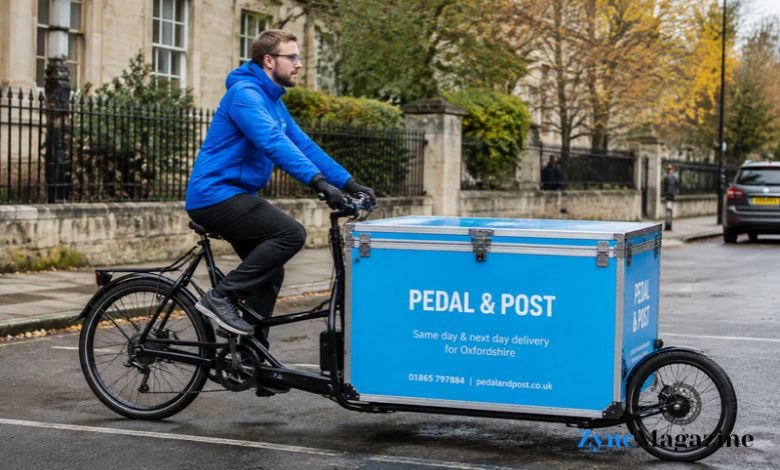
The pedal and post collapse has become a notable story in the UK’s urban delivery industry. Pedal & Post, an Oxford-based courier company built around cargo bikes and low-emission transport, stopped trading in early 2026 after operating for more than a decade. The company had become known for moving parcels, local goods and important medical supplies through city streets without relying heavily on traditional delivery vans. Its closure therefore raised wider questions about the future of sustainable urban logistics.
Pedal & Post was founded in Oxford in 2013 by Christopher Benton. During its years of operation, the company developed a delivery model based on cargo bikes, bicycle trailers and last-mile services. It worked with local customers as well as larger logistics businesses and expanded its operations into London in 2025. According to reports, around 60 people working across Oxford and London were affected when the company closed.
The company’s own announcement made clear that the closure was linked to the loss of a major client. After reviewing its options and forecasts, management concluded that the business could no longer be sustained. The formal insolvency record shows that Pedal & Post entered a Creditors Voluntary Liquidation on 20 February 2026.
What Was Pedal & Post?
Pedal & Post was more than a traditional bicycle courier service. It developed a model designed for urban freight and last-mile delivery, where goods need to move through busy areas efficiently and with less impact on the environment.
The company began in Oxford in 2013 and spent years building its presence in the city. Its cargo bikes and bike trailers were used for deliveries ranging from everyday local items to larger commercial loads. The business also worked with major logistics firms, including DPD, Yodel and Evri, according to reporting by Cherwell.
One of the most important parts of its work involved medical logistics. Pedal & Post carried critical medical deliveries, including cancer medication, for hospitals and NHS trusts. This demonstrated that cargo-bike delivery was not limited to small parcels or food boxes. It could also support time-sensitive urban supply chains.
The idea behind the company was simple but increasingly relevant to cities. Instead of sending another van into a crowded city centre, some deliveries could be completed using a cargo bike. This could reduce the number of larger vehicles entering busy streets while also making it easier to navigate areas with congestion, parking restrictions and limited road space.
Why Did Pedal and Post Collapse?
The most important reason behind the pedal and post collapse was the loss of a major customer.
In its public statement, Pedal & Post said it had lost a major client earlier in 2026. The company explained that it had explored every possible option for continuing but eventually reached the point where it could no longer sustain operations. This was followed by the closure of both its Oxford and London sites.
Local reporting identified the lost customer as Voi, an e-scooter rental company, with Pedal & Post reportedly providing services connected to e-bikes and e-scooters. Cherwell reported that the loss of this contract was a major factor in the decision to close.
The situation shows how vulnerable a smaller logistics company can become when a significant share of its income comes from a limited number of major contracts. A large logistics business may be able to absorb the loss of one customer because it has many other sources of revenue. For a smaller specialist operator, losing one major contract can create a much larger financial gap.
Christopher Benton later explained that the business depended on roughly five or six major clients. That concentration meant that losing one of them could make continued operations difficult even when the wider business remained operationally capable.
The Company Had Been Expanding
The closure came at an especially notable time because Pedal & Post had recently expanded into London.
The company had spent more than ten years operating in Oxford before taking its cargo-bike model to another major UK city. London offered a large potential market for low-emission delivery because of its dense streets, traffic levels and growing interest in sustainable transport.
However, expansion also brings additional costs and operational demands. Opening or maintaining a second location requires people, equipment, management and enough customer demand to support the operation. When the major contract was lost, the company was left facing the challenge of supporting its wider operation without an important source of income.
The timing made the closure particularly striking. A company that had invested in expansion only months earlier found itself unable to continue after a major commercial relationship ended.
Around 60 Jobs Were Lost
The impact of the collapse was not limited to company finances. Around 60 jobs across Oxford and London were affected, with reports describing the workforce as a mixture of employed and self-employed people.
For the riders and other workers involved, the closure meant the sudden end of a business that had developed a distinctive working culture around bicycle-based delivery. Pedal & Post had also presented itself as an ethical employer in an industry where self-employed courier arrangements are common.
The company argued that the lower operating costs associated with cargo bikes had helped it create better working conditions and pay. Its closure therefore represented not only the loss of a delivery company but also the loss of a particular approach to how urban logistics could be organised.
Did Customers Notice the Closure?
The collapse also had consequences beyond Pedal & Post itself.
Pedal & Post had worked with national logistics businesses as part of wider last-mile delivery networks. When the company stopped operating, at least some partner services were temporarily affected.
Motor Transport reported disruption involving Evri after the cargo-bike company ceased trading. Evri subsequently reorganised the affected deliveries and said normal service was being restored. This is a useful reminder that a small specialist operator can still play an important role inside a much larger delivery system.
Modern logistics often works through multiple companies rather than a single organisation handling every stage. A parcel may pass between warehouses, large carriers, local delivery firms and specialist last-mile operators. If one link suddenly disappears, other companies have to adapt quickly.
When Did Pedal & Post Enter Liquidation?
There is a difference between the company stopping trading and entering a formal legal liquidation process.
Pedal & Post announced that its operations had come to an end in early 2026. Companies House records show that the company entered a Creditors Voluntary Liquidation, with the winding-up commencing on 20 February 2026. Joint liquidators were appointed on the same date.
The Gazette also published formal notices confirming the voluntary winding-up resolution and the appointment of joint liquidators.
Companies House records list Pedal & Post Ltd as having been incorporated on 7 May 2013. The company’s current status is listed as “Liquidation”.
These official records matter because they confirm that the pedal and post collapse was a formal business failure rather than a short-term pause in trading.
Why Cargo Bikes Made Sense for Urban Deliveries
The business model behind Pedal & Post was based on a problem faced by many cities: how to move goods efficiently without adding more vans to already crowded roads.
Cargo bikes are particularly useful for short urban routes. They can often move through narrow streets and dense areas more easily than larger vehicles. They also take up less road and parking space.
For businesses delivering multiple items in a city centre, this can provide practical benefits. A cargo bike can stop closer to a destination without searching for a large parking space, while a rider may be able to avoid some of the delays faced by vehicles in heavy traffic.
Pedal & Post’s history provided a real-world example of this approach. During its 14 years in Oxford, the company delivered millions of items and worked with residents, local businesses and national logistics companies. It also transported important medical supplies.
That does not mean cargo bikes are suitable for every delivery. Large, heavy or long-distance shipments may still require vans or lorries. The strongest use case is often the last mile in dense urban areas, where flexibility and access can matter as much as carrying capacity.
Does the Collapse Mean Cargo Bike Logistics Has Failed?
No. This is one of the most important points to understand about the pedal and post collapse.
Pedal & Post itself said that its closure was not a reflection of the viability of cargo bikes or cargo-bike logistics. In its final statement, the company argued that the market had changed significantly since it started and pointed to growing interest from major carriers in low-carbon, bike-based urban delivery.
A company can fail even when the basic idea behind its business remains valuable.
Businesses succeed because of many factors, including customer contracts, operating costs, cash flow, management, market demand and competition. A sustainable transport company must deal with these commercial realities just like any other company.
Pedal & Post’s closure therefore says more about the financial resilience of one company than about whether cargo bikes have a place in the future of city logistics.
The Bigger Lesson for Sustainable Delivery
There is a wider lesson hidden inside the collapse.
Sustainable businesses often attract attention because of their environmental benefits, but good intentions alone cannot guarantee long-term survival. A company still needs predictable income, a diverse customer base and enough financial strength to survive unexpected changes.
For Pedal & Post, dependence on a relatively small group of major customers appears to have increased the risk. When a major client was lost, the company did not have enough room to absorb the shock.
That is an important lesson for other green logistics companies. Building demand across different sectors can provide more stability than relying heavily on one major contract. It also shows why sustainable transport businesses need commercial models that are as strong as their environmental goals.
What Is the Legacy of Pedal & Post?
Although the company has closed, its work has left a clear mark on Oxford’s delivery landscape.
For more than a decade, Pedal & Post showed that cargo bikes could be used for serious commercial logistics. Its work included everyday local deliveries, major courier partnerships and medical transport. Its riders became a familiar sight in Oxford, while its later London expansion demonstrated an ambition to take the model further.
The company also helped normalise the idea that a delivery service does not always need a conventional van. As cities continue to consider congestion, pollution and the use of road space, that lesson remains relevant.
The closure is certainly a setback for the company, its employees and the customers who depended on it. But the example it created can still influence future urban delivery models.
What Happens Next for Urban Cargo Delivery?
The end of Pedal & Post does not mean urban cargo-bike delivery will disappear. In fact, the company’s own final message suggested the opposite.
Technology, cargo-bike design and urban logistics have changed considerably since 2013. Modern electric cargo bikes can carry larger loads and operate more efficiently than many early models. At the same time, major delivery companies are exploring lower-emission ways of completing city-centre deliveries.
This means the market may continue to develop even though individual companies come and go.
The future may involve a mix of business models, with larger logistics companies operating their own cargo-bike networks and smaller specialists handling specific areas or customer types. The strongest businesses will likely be those that combine efficient operations, reliable contracts and sustainable transport.
Pedal & Post was an early participant in that transition. Its closure is part of the history of the industry, rather than necessarily its endpoint.
Conclusion
The pedal and post collapse was a major development for the UK’s sustainable delivery sector. Pedal & Post, founded in Oxford in 2013, spent more than a decade proving that cargo bikes could handle practical urban logistics, including parcel delivery, commercial work and important medical supplies.
The immediate trigger for the closure was the loss of a major client, which the company said made continued operations unsustainable despite attempts to find a way forward. Both Oxford and London operations closed, affecting around 60 workers.
The company then entered a Creditors Voluntary Liquidation on 20 February 2026, according to official Companies House records.
While the collapse is a sad ending for Pedal & Post, it should not be viewed as proof that cargo bikes cannot succeed. The company’s own message was that cargo-bike logistics still has a future. The bigger lesson is that sustainable delivery requires not only a strong environmental purpose but also stable customers, careful financial planning and a resilient business model.
(FAQs)
What was Pedal & Post?
Pedal & Post was a UK courier and urban logistics company founded in Oxford in 2013. It specialised in cargo-bike deliveries, last-mile logistics and other low-emission transport services.
Why did Pedal & Post close?
The company closed after losing a major client. Its management said that, despite exploring different options, the loss made the business unsustainable.
How many workers were affected?
Around 60 people across the Oxford and London operations were affected by the closure.
When did Pedal & Post enter liquidation?
The formal Creditors Voluntary Liquidation began on 20 February 2026, with joint liquidators appointed on that date.
Does Pedal & Post’s closure mean cargo bikes are no longer useful?
No. The closure was the failure of one business, not the failure of cargo-bike logistics as a concept. Pedal & Post itself said it believed there was still a future for cargo-bike delivery and sustainable urban logistics.