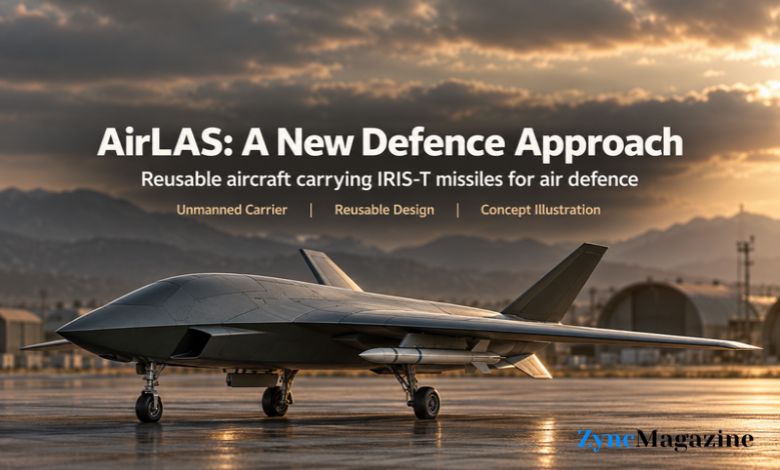
AirLAS takes a familiar defence weapon and gives it a different way to travel. Rather than launching only from a ground position or a crewed fighter, the project places an air-to-air missile on a reusable unmanned aircraft. The aim is to expand where defensive weapons can operate and give armed forces more choice over their launch positions.
Developed by Diehl Defence and POLARIS Raumflugzeuge, the German programme combines missile technology with an unmanned carrier. Its name means Airborne Launching and Attack System, as described in Diehl’s original announcement. The concept centres on integrating the IRIS-T missile with a POLARIS aircraft to extend defensive reach.
A successful first flight of the COBRA prototype has since added a practical milestone. However, understanding AirLAS means looking at both its promise and what that flight actually demonstrated.
What Is AirLAS?
AirLAS is a programme to develop an airborne missile carrier for defence missions. POLARIS describes its COBRA aircraft as an uncrewed platform primarily intended to carry and launch IRIS-T air-to-air missiles. The aircraft provides transport, while the missile performs the interception.
A useful comparison is a delivery vehicle carrying a specialised tool. Moving the vehicle changes where the tool becomes available, but it does not automatically change everything the tool can do. In the same way, a missile carrier’s flight distance should not be confused with the missile’s own engagement range.
This distinction helps explain the project without overstating it. AirLAS is about creating a mobile airborne launch option, with the complete system’s effectiveness depending on more than distance alone.
How the Partnership Began
Diehl Defence announced the cooperation agreement on 18 June 2025 at the Paris Air Show. The agreement brought together the companies’ work on guided weapons and unmanned aircraft, with increased operational reach among the stated goals.
POLARIS brings an unusual background to the partnership. Based in Bremen, it develops reusable space launch and hypersonic transport technology designed to operate like aircraft. Its wider ambition includes vehicles that take off from airports, return and fly again.
That background helps explain the company’s interest in reusable carriers. Nevertheless, experience from one aircraft programme does not remove the need to test a new defence application. Carrying equipment, releasing a weapon and returning safely each introduce different demands.
Why the IRIS-T Missile Matters
The IRIS-T gives AirLAS an existing weapon around which to develop its carrier concept. Diehl states that the missile was created for air-to-air missions through a European cooperation programme and has been produced since 2005.
Its features include an imaging infrared seeker and control systems designed for high agility. In simple terms, the seeker helps the missile track a target, while its controls allow it to change direction quickly. IRIS-T has also been selected for several fighter aircraft, including the Eurofighter and Gripen.
Using an established missile can narrow the development task, but fitting it to a different aircraft remains substantial work. Engineers must show that the carrier, launcher, software and weapon function safely together. A missile’s previous service record does not prove the readiness of every new platform carrying it.
What the COBRA First Flight Shows
POLARIS announced that the COBRA prototype completed its first flight, covering more than 20 kilometres. The company also said further flights would follow in the coming months. This provides evidence that the aircraft has moved into flight testing.
The distance needs context. A flight covering 20 kilometres is a test milestone, rather than a statement of maximum range. It also does not, by itself, establish that an aircraft has completed missile launches or intercepted a target.
For readers following AirLAS, those distinctions matter. A prototype flying successfully answers an early question about the aircraft. Later demonstrations must answer different questions about payload performance, weapon integration and dependable operation.
How an Airborne Carrier Could Help Air Defence
The potential appeal of an airborne launcher is flexibility. As a general principle, moving a weapon’s launch position can create options that are unavailable from a single ground location. This is the central logic behind interest in a reusable missile carrier.
Consider a simplified example: a defensive weapon is needed beyond the area immediately surrounding its base. A carrier could transport that weapon before launch. Whether this produces a useful military advantage would depend on detection, communications, flight time and the threat being faced.
Aircraft range and defensive coverage are therefore different measures. A carrier might travel a considerable distance without being able to protect every point along that route. Effective coverage also requires reliable information about targets and a system capable of responding in time.
Why Reusability Matters
Reusability is central to POLARIS’s wider aircraft approach. The company describes a future in which its spaceplanes return to airports and operate repeatedly, placing repeated use at the heart of its development work.
Applied to a missile carrier, the possible economic benefit is straightforward: an aircraft that returns may be prepared for another mission. Its cost can potentially be spread across multiple flights, provided recovery and maintenance remain practical.
That benefit must be assessed across the full operating cycle. Fuel, inspections, repairs, training and ground support all affect the final cost. Reusable describes a design goal; cost-effective requires evidence about how reliably and affordably the aircraft can fly again.
Could AirLAS Have Wider Applications?
Diehl’s initial announcement identified possible maritime applications and potential links with the Future Combat Air System. It also mentioned longer-term opportunities involving hypersonic systems. These were presented as future possibilities rather than completed capabilities.
In particular, a connection to hypersonic research does not establish that the current COBRA aircraft flies at hypersonic speed. Separate projects can share knowledge, manufacturing methods or design experience while having very different performance.
Any maritime application would also need its own assessment. Operating around ships and coastal environments introduces questions about support, weather exposure and coordination. A promising idea becomes useful only when those practical details work together.
What Will Determine the Programme’s Success?
The most useful next developments will be demonstrations that show how the complete system performs. Flight reliability, safe weapon integration and repeatable recovery are more meaningful measures than an impressive illustration or an ambitious headline.
A practical assessment should also ask how the aircraft fits into existing defence operations. Operators need equipment they can prepare, control, maintain and support under demanding conditions. A successful prototype is an important beginning, while a dependable service system requires a much broader body of evidence.
For AirLAS, the strongest case will come from connecting its central idea with measurable results: carrying a weapon safely, supporting a defence mission and making the carrier available for further use.
Conclusion
AirLAS offers a clear and interesting proposition: use a reusable unmanned aircraft to give a defensive missile greater freedom of movement. The COBRA flight announcement provides a concrete development milestone, while further testing will determine how much of the wider ambition becomes practical.
Its progress deserves attention because it explores a different relationship between aircraft and air defence. The decisive question is whether that relationship can deliver reliable performance at a sustainable cost.
Frequently Asked Questions
1. What does AirLAS stand for?
Diehl Defence’s original announcement uses Airborne Launching and Attack System. It describes a project combining an unmanned POLARIS carrier with a guided missile.
2. Who is developing AirLAS?
Diehl Defence and POLARIS Raumflugzeuge are developing the programme together. Their cooperation brings missile expertise and reusable aircraft development into one project.
3. Which missile is intended for AirLAS?
The planned weapon is the IRIS-T air-to-air missile. POLARIS identifies carrying and launching this missile as COBRA’s primary intended defence role.
4. Has the COBRA aircraft flown?
Yes. POLARIS announced a successful prototype flight covering more than 20 kilometres. That distance describes the reported test flight, rather than its maximum operating range.
5. Is AirLAS ready for military service?
The first-flight announcement establishes progress in aircraft testing. It does not establish full operational readiness, which requires evidence about the integrated aircraft, weapon and supporting systems.