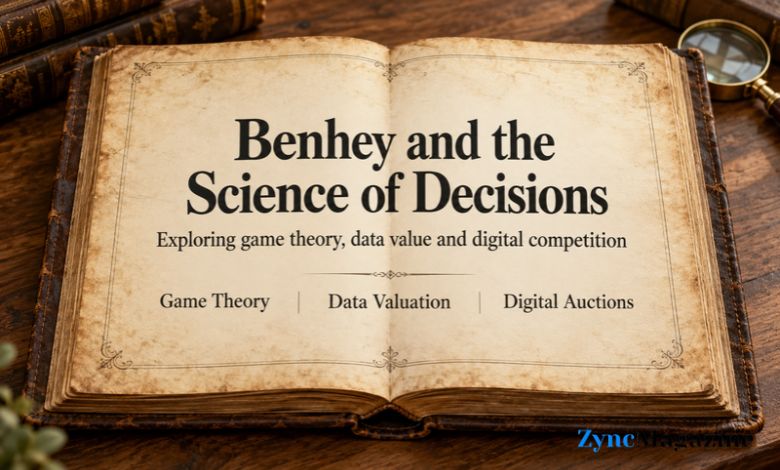
You may come across Benhey beside an academic paper, a research project or a discussion about digital advertising. The name offers little explanation on its own. Its meaning becomes clearer when it is connected to the person and work behind it
Within academic research, that connection is Benjamin Heymann. His background brings together engineering, operations research and applied mathematics, while his research interests include game theory. These fields share a practical concern: understanding how decisions work when the situation is complicated
That concern reaches well beyond universities. Businesses decide where to spend money, digital services choose which opportunities to pursue, and researchers assess which information helps a system improve. Exploring these questions provides a useful way to understand the research associated with Benhey
Who Is Benhey?
Benhey forms part of the address of Benjamin Heymann’s personal academic website. It is therefore a recognisable connection to his research identity, although it should not be treated as proof that every similarly named account belongs to him
Heymann describes himself as a Staff Research Scientist at Criteo AI Lab, where he leads the Performance Science team. He also identifies himself as a member of the joint Inria/Criteo FairPlay team
His stated focus includes game theory, with attention to both theoretical and applied topics. This combination matters because research can serve two related purposes: improving our understanding of a problem and developing methods that may help address it
A Background That Connects Theory With Practical Problems
Heymann holds an engineering degree from École Polytechnique, a Master of Science in Operations Research from Columbia University, and a doctorate in applied mathematics from École Polytechnique/Inria
Although these qualifications cover different subjects, they fit together naturally. Engineering asks how a system can work effectively. Operations research examines how available resources can be used. Applied mathematics provides methods for studying the relationships involved
Think of a business trying to organise deliveries. It has customers to serve, vehicles to assign and deadlines to meet. Understanding each part separately is useful, but the difficult work involves making those parts function together. Mathematical reasoning helps turn that difficulty into a problem that can be examined
Game Theory Starts With Other People’s Choices
The name game theory can make the subject sound distant from everyday life. Its central idea, however, is familiar: your best decision often depends on what someone else decides
Suppose two businesses sell similar products. One lowers its prices, hoping to attract more customers. The other must choose a response. Matching the reduction could protect sales, but it could also reduce earnings for both businesses
The first business cannot assess its decision properly without considering that response. Neither participant acts in an empty space. Their choices influence one another
Game theory gives researchers a way to describe these situations. It sets out who participates, what choices they have and which outcomes they prefer. From there, the relationships between different strategies can be studied
Why a Sensible Choice May Still Disappoint
A decision can be reasonable based on the available knowledge and still produce an unwanted result. Another participant may behave unexpectedly, or an important detail may have been unknown
This is one reason assumptions deserve attention. A model that assumes complete knowledge may reveal something useful, but its conclusions need care when applied to people working with uncertainty
Data Valuation Looks at Contribution, Not Just Quantity
It is easy to assume that a system improves whenever more data is added. Data valuation takes a closer look at that assumption by asking what particular information contributes to a defined task
Imagine a tool learning to recognise handwritten numbers. If it already handles neat handwriting well, adding more neat examples may bring only a small improvement. Examples of difficult handwriting might address a more serious weakness
The value comes from the contribution, rather than the number of files collected. That contribution also depends on what the system already has. An example that is useful early in a project may add less once similar material becomes common
This makes data valuation a question about context. Information needs to be assessed against a purpose, with a clear understanding of what improvement would mean
Different Goals Can Produce Different Answers
One project might aim for greater accuracy. Another may need to reduce processing costs or improve performance on unusual cases
The same data could support these goals differently. Before comparing collections, it helps to establish what the project needs and which measures can show whether those needs are being met
Digital Auctions Bring Several Difficult Choices Together
An auction may look simple from the outside: participants bid, and someone wins. Digital auctions become more complicated when opportunities arrive repeatedly and bidders have limited budgets
In a simplified advertising example, a business must decide how much an opportunity to show an advert is worth. It needs to consider the possible benefit, the price and what it may need to spend later
Winning every opportunity would not necessarily be sensible. A business could exhaust its budget on placements that offer little benefit. Being too cautious could also mean missing worthwhile opportunities
Repeated bidding creates further uncertainty. Participants can learn from previous results and change their behaviour. A strategy that worked earlier may need adjustment as the competitive conditions change
Operations Research Makes Constraints Part of the Decision
Many plans look attractive until practical limits are considered. There may be too little time, too few staff or a budget that cannot cover every option
Operations research begins by taking those limits seriously. It helps compare choices within the conditions that actually apply
A hospital scheduling appointments, for example, must consider staff availability, room capacity and the time different appointments require. Filling every available slot may look efficient, but the plan also needs to function when delays occur
The broader lesson is useful outside technical work. A strong decision should account for both the desired outcome and the resources needed to achieve it
How to Read Research Without Getting Lost
A technical paper can feel difficult before its central question becomes clear. Starting with that question often makes the rest easier to follow
Ask what problem the researchers are examining and why it matters. Then look at the proposed approach. What changes, and how is the result assessed?
It also helps to identify the kind of evidence involved. A mathematical proof establishes a result under stated conditions. A simulation examines a designed situation. An experiment provides evidence from a particular setting
These approaches offer different kinds of insight. Understanding their roles helps avoid treating every promising result as a guarantee of practical success
What Makes the Benhey Connection Interesting?
The interest lies in the questions behind the research. How should competing participants respond to one another? Which information deserves attention? How can limited resources support better decisions?
These questions encourage a more thoughtful view of technology. A system should not be judged only by how much data it holds or how complicated its methods sound
The useful questions concern purpose and evidence. What is the system trying to achieve? How is success measured? Under which conditions does the approach work well? Those questions remain valuable even when the technical details are unfamiliar
Conclusion
Benhey’s academic connection to Benjamin Heymann provides a starting point for understanding game theory, data valuation and strategic decision-making. His background connects mathematical analysis with problems involving competition, information and limited resources
For a general audience, the most useful lesson is to look closely at how conclusions are reached. Clear goals, realistic assumptions and suitable evidence make complicated ideas easier to understand—and make claims about technology easier to judge
Frequently Asked Questions
1. Who is Benhey?
In this academic context, Benhey is connected to Benjamin Heymann through his personal website address. Similar names elsewhere require additional context before an identity can be established
2. What does Benjamin Heymann research?
His stated research focus includes game theory. His work also connects with subjects such as data valuation and auctions
3. What qualifications does Benjamin Heymann hold?
His academic background includes engineering at École Polytechnique, operations research at Columbia University and a doctorate in applied mathematics from École Polytechnique/Inria
4. Why is data valuation useful?
It helps assess how information contributes to a particular goal. This supports more careful decisions about which data to collect, retain or use
5. Can someone understand these subjects without advanced mathematics?
Yes, everyday examples can explain the central questions. Advanced mathematics becomes necessary when studying formal models, detailed methods and proofs