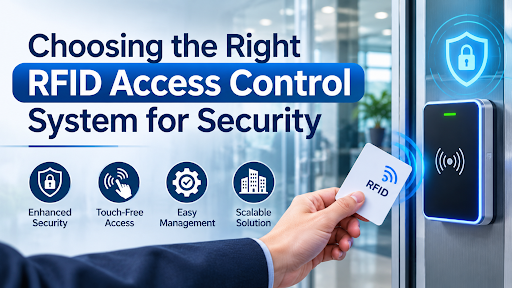
Modern businesses and industrial facilities need effective security measures to protect employees, visitors, valuable equipment, and restricted operational areas. As workplaces become more advanced, traditional security methods such as physical keys and manual entry registers may no longer provide the flexibility and control organizations require. An RFID access control system offers a practical approach to managing workplace entry through radio frequency identification technology.
By using RFID cards, tags, and readers, businesses can identify authorized personnel, control access permissions, and monitor entry activities. However, selecting the right solution requires careful consideration of security requirements, environmental conditions, operational needs, and future expansion. We should evaluate several important factors before investing in an RFID-based access management system.
Understanding How an RFID Access Control System Works
Radio Frequency Identification (RFID) technology uses electromagnetic signals to identify and communicate with RFID-enabled devices. An RFID access control system typically consists of three essential components: RFID tags or cards, RFID readers, and a central access management platform.
Employees or authorized visitors carry RFID cards, badges, or other identification devices containing unique credentials. When someone approaches an RFID reader, the device detects the tag and communicates its identification information to the access control system. The system then checks the credentials against its authorization database and determines whether entry should be permitted.
If the credentials match the assigned access permissions, the system grants access. Otherwise, it denies entry to the restricted area. Depending on the configuration, administrators can also maintain access records and review entry activities.
Understanding this process helps businesses identify the equipment and functionality required for their facilities.
Security and Access Management Requirements
Security should remain a primary consideration when selecting RFID access control solutions. Every organization has different requirements depending on its facility size, workforce, operational activities, and security risks.
For example, a manufacturing facility may need to restrict access to production floors, equipment rooms, warehouses, and hazardous operational zones. Similarly, corporate offices may require different permissions for employees, management teams, contractors, and visitors.
We should look for a system that supports:
- Role-based access permissions: Assign entry privileges according to employee responsibilities and job positions.
- Restricted-area management: Prevent unauthorized individuals from entering sensitive or high-security locations.
- Individual identification: Associate RFID credentials with specific employees or authorized visitors.
- Access activity records: Maintain records of entry attempts and authorized access events.
- Credential management: Allow administrators to deactivate lost, stolen, or outdated RFID cards.
A reliable RFID security system should also provide appropriate administrative controls to help security teams manage permissions efficiently. For facilities with higher security requirements, organizations can evaluate additional authentication methods, such as PIN verification or biometric identification.
Ease of Use and Touch-Free Access Control
Workplace security should not create unnecessary delays for employees or visitors. An effective system needs to balance strong protection with convenient everyday operation.
Touch-free access control is one of the important advantages of RFID technology. Employees can present their RFID cards or badges near a compatible reader without inserting a physical key or manually entering identification details.
This contactless identification process can make workplace entry more convenient, particularly in facilities with frequent employee movement, multiple entry points, or shift-based operations.
RFID identification can also simplify access management for organizations with large workforces. Instead of distributing and managing multiple physical keys, administrators can assign individual credentials and update access permissions through a centralized platform.
When choosing a solution, we should consider reading distance, authentication speed, reader placement, and compatibility with the identification devices employees will use.
Scalability and Integration With Existing Systems
Business requirements change over time. A company may expand its workforce, introduce additional production areas, establish new facilities, or increase the number of restricted locations.
Therefore, an RFID access control system should support future growth without requiring organizations to replace their entire security infrastructure.
We should evaluate whether the system can accommodate additional RFID readers, identification devices, entry points, and users. Centralized administration can also make it easier to manage multiple locations through a consistent access management platform.
Integration is another important consideration. Depending on operational requirements, modern RFID access control solutions may work alongside:
- Employee and workforce management platforms.
- Visitor management systems.
- Time and attendance software.
- Video surveillance and security monitoring systems.
- Existing building management infrastructure.
These integrations can help organizations coordinate security activities and reduce repetitive administrative tasks. Before selecting a solution, we should confirm compatibility with existing hardware, software, and communication protocols.
Environmental Conditions and System Reliability
Industrial environments often expose security equipment to conditions that can affect performance. Dust, moisture, temperature fluctuations, vibration, and electromagnetic interference may influence equipment suitability.
For this reason, we should evaluate the operating environment before selecting RFID readers and identification devices.
For example, outdoor access points may require weather-resistant equipment, while manufacturing facilities may need durable readers designed for demanding industrial conditions. Similarly, warehouses and large operational sites may require suitable reader placement to ensure reliable identification.
Other factors worth reviewing include:
- Operating temperature and humidity requirements.
- Protection against dust and water exposure.
- Equipment durability and expected service life.
- Power supply and backup arrangements.
- Communication reliability and network availability.
- Maintenance requirements and technical support.
Choosing equipment that matches the actual working environment can help reduce operational interruptions and support consistent access management.
RFID Technology and Identification Requirements
Not every RFID technology is suitable for every application. Organizations should understand the differences between available RFID frequencies and identification methods before making a decision.
Low-frequency (LF), high-frequency (HF), and ultra-high-frequency (UHF) RFID technologies serve different operational purposes.
LF and HF technologies are commonly used in identification and proximity-based applications, while UHF technology can support longer reading distances in suitable environments. However, the appropriate option depends on the application, reader design, tag specifications, and surrounding materials.
We should also consider the type of RFID credentials required. Cards and badges may suit office environments, while industrial operations may benefit from more durable tags or specialized identification devices.
For facilities managing large workforces or multiple operational zones, RFID personnel identification should provide consistent and dependable identification across all relevant access points.
Choosing the Right RFID Access Control Solution
Selecting the right system requires more than comparing equipment prices. We should assess the complete operational requirements and identify a solution that delivers appropriate security, usability, and long-term value.
Before making a final decision, businesses should consider the following questions:
- What areas require protection? Identify entrances, restricted zones, production areas, warehouses, and sensitive locations.
- How many users need access? Estimate the current workforce and potential future growth.
- Which identification technology is suitable? Compare RFID frequencies, reading distances, and credential options.
- Does the system support integration? Check compatibility with existing security and workforce management platforms.
- Can access permissions be managed centrally? Look for administrative tools that simplify credential management.
- Is the equipment suitable for the environment? Evaluate durability, weather protection, and operating conditions.
- What support is available? Review installation, maintenance, technical assistance, and system upgrade options.
Businesses exploring modern industrial security applications can also review specialized RFID access control systems to understand how RFID technology can support personnel identification and controlled access in different operational environments.
Comparing these factors helps organizations select an appropriate solution rather than investing in equipment that may not meet their actual requirements.
Why Consider IDENTEC for RFID Access Control Solutions?
When evaluating RFID access control solutions, businesses should consider manufacturers with established experience in RFID technology and a strong understanding of industrial and commercial security requirements. IDENTEC Limited is a UK-based manufacturer specializing in touch-free radio frequency identification systems for commercial and industrial applications.
With experience dating back to 1982, IDENTEC develops RFID tags, readers, antennas, and accessories designed to support different identification and tracking requirements. Its technology is used across several applications, including access control, personnel identification, safety registration, asset tracking, hygiene management, and car parking.
One of the key features of IDENTEC’s technology is its hands-free access control capability. Depending on the system configuration, RFID tags can be detected automatically as authorized personnel approach or pass through designated entry and exit points. This approach can reduce the need for employees to stop and present identification cards manually.
IDENTEC also offers directional sensing technology, which can help businesses distinguish between people entering and leaving designated areas. This functionality is particularly useful in industrial facilities, workplaces, and environments where monitoring personnel movement is important for security and safety management.
Another consideration is system compatibility. IDENTEC’s RFID technology can integrate with third-party access control systems, allowing businesses to explore solutions that complement their existing security infrastructure.
Organizations looking for specialized RFID access control systems can explore IDENTEC’s RFID technology and access control solutions. Its product range and application-specific capabilities provide useful options for businesses seeking touch-free personnel identification, controlled entry, and improved operational visibility.