Latest Breakthroughs in Quantum Computing 2024: The Developments That Mattered Most

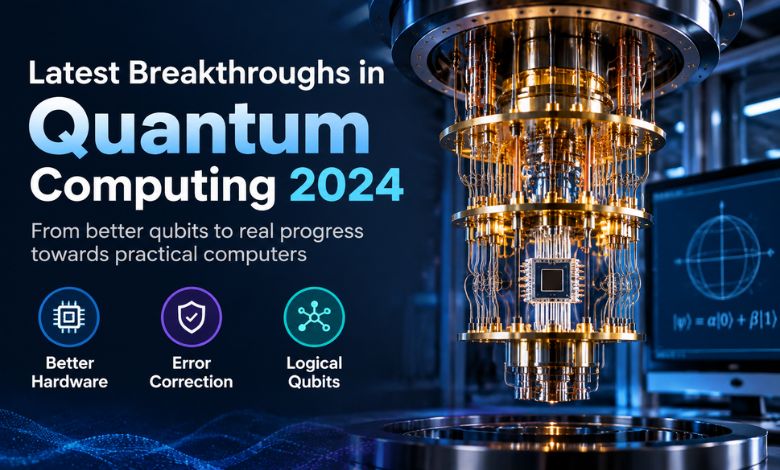
Quantum computing had a fascinating year in 2024. There was a lot of attention around new processors and impressive research results, but the most important progress was not simply about putting more qubits on a chip. Researchers spent much of the year trying to answer a harder question: Can quantum computers become reliable enough to do useful work?
That question is at the heart of the entire industry.
Quantum computers have the potential to handle certain problems in ways that conventional computers cannot easily match. They could eventually help with areas such as chemistry, materials research, drug development, optimisation and cryptography. However, today’s quantum machines are still extremely sensitive to errors.
A small disturbance can change the state of a qubit and affect the final result. Because of this, researchers are working on better hardware, smarter error correction and ways to build larger systems without losing accuracy.
The major developments of 2024 showed that progress is being made on several of these problems at the same time.
The Quantum Computing Race Started Changing
For years, one of the easiest ways to talk about quantum computing was to mention the number of qubits in a processor. More qubits sounded like a clear sign that a company was ahead.
In 2024, that approach started to look less useful.
A processor can have a large number of qubits and still struggle if those qubits are too noisy or difficult to control. What matters is not just how many qubits exist, but how well they work together.
This is why terms such as error rate, gate fidelity, coherence and logical qubits became much more common in discussions about quantum technology.
It was a sign that the industry was becoming more focused on building machines that can eventually perform meaningful calculations rather than simply producing impressive hardware specifications.
Google’s Willow Chip Drew Huge Attention
Google made one of the biggest quantum computing announcements of the year when it introduced its Willow quantum chip in December 2024.
The company said Willow had achieved a significant milestone in quantum error correction. In Google’s experiments, increasing the size of the error-correcting code reduced the error rate of the encoded quantum information. This is known as operating below the error-correction threshold and is an important goal for researchers trying to build fault-tolerant quantum computers.
Why is that such a big deal?
Quantum errors are one of the main reasons it is difficult to scale these machines. Adding more physical qubits does not automatically make a system better. In fact, a larger machine can create more opportunities for things to go wrong.
A useful error-correction system should therefore become more effective as the system grows.
Google also reported that Willow completed a specialised benchmark computation in less than five minutes and compared that result with an estimate for how long a leading classical supercomputer would need for the same task. The benchmark was designed as a demonstration of quantum performance rather than a normal real-world application.
Still, the error-correction result was arguably the more important part of the announcement.
Logical Qubits Became a Bigger Priority
One of the most interesting ideas in quantum computing is the logical qubit.
A physical qubit is the actual quantum element inside a processor. Physical qubits are fragile and can make mistakes. A logical qubit uses several physical qubits together with an error-correction method to protect the information.
It is a little like keeping an important message safe by storing enough information about it to recover the original when something goes wrong.
Quantinuum and Microsoft reported an important demonstration in April 2024. They announced that they had created four logical qubits and achieved a significantly lower error rate in the logical system compared with the underlying physical qubits.
The companies reported that the logical circuit error rate was around 800 times lower than the corresponding physical error rate in their experiment.
The importance of this result goes beyond the headline number. It showed that error correction can genuinely improve the reliability of quantum information rather than simply adding another layer of complexity.
Later in 2024, Quantinuum announced work involving 12 logical qubits, showing that researchers were continuing to push the idea towards larger systems.
This is likely to remain one of the main goals of quantum computing for years to come.
IBM Continued Improving Its Heron Processors
IBM was also busy throughout 2024.
The company continued developing its Heron quantum processors, with a version reaching 156 qubits. IBM’s work placed strong emphasis on improving the quality of quantum operations rather than simply increasing the qubit count.
That distinction matters.
A quantum algorithm may require many operations to be performed one after another. Even a small error at each stage can eventually ruin the calculation. Better gate performance therefore gives researchers a better chance of running deeper and more complicated circuits.
IBM also reported improvements in its ability to run circuits with large numbers of two-qubit operations. Its research into connecting quantum chips was another part of the company’s longer-term approach to scaling.
Instead of assuming that the future quantum computer must be one enormous chip, researchers are increasingly considering modular architectures, where multiple processors can work together.
That could provide a more practical path toward larger machines.
Artificial Intelligence Entered the Error-Correction Conversation
Another interesting development in 2024 was the growing relationship between AI and quantum computing.
Google introduced AlphaQubit, an AI-based system designed to help decode errors in quantum systems. Error correction produces information that has to be interpreted quickly, and this becomes increasingly difficult as a quantum computer gets larger.
Machine learning may offer a useful way of handling that information.
Google reported that AlphaQubit performed better than the comparison decoding techniques used in its testing. That does not mean artificial intelligence has solved quantum error correction, but it shows how AI could become part of the supporting technology around future quantum processors.
The connection between the two fields could become even stronger. AI may help with calibration, error detection, optimisation and the day-to-day control of increasingly complicated quantum machines.
Better Hardware Is Only Half of the Story
A powerful quantum computer needs more than a good processor.
Researchers also have to deal with cooling, control electronics, chip connections, measurement systems and software.
Some types of quantum hardware have to operate under extremely controlled conditions. Keeping the system stable while performing large numbers of operations is a major engineering challenge.
This is one reason why scalability is such an important word in quantum computing.
A technology may work beautifully in a laboratory demonstration but become much harder to manage when the system is made ten or one hundred times larger.
The breakthroughs of 2024 were useful partly because they addressed this gap between a small experiment and a machine that might eventually operate at a much larger scale.
Why Error Correction Could Be the Real Turning Point
It is tempting to think that the future of quantum computing is mainly a race for speed.
In reality, reliability may be more important than speed.
Imagine a quantum computer that can complete a calculation very quickly but frequently produces the wrong answer. That machine would not be particularly useful for serious scientific or commercial work.
A slower machine that can consistently produce accurate results could be much more valuable.
This is why developments in quantum error correction deserve so much attention. If researchers can create reliable logical qubits and keep their error rates under control, they may finally have a realistic foundation for much larger quantum computers.
The work done in 2024 suggested that this goal is becoming less theoretical.
Where Could Quantum Computing Be Used?
People often talk about quantum computing as though its applications are already here. The reality is more complicated.
Many potential applications are still being researched.
In drug discovery, quantum computers could eventually help scientists study molecular structures and chemical interactions. In materials science, they may help researchers understand materials at a detailed quantum level.
There is also interest in optimisation problems, financial modelling and certain types of machine learning.
Cryptography is another major area. Large future quantum computers could threaten some existing encryption methods, which has encouraged governments and businesses to prepare for a post-quantum security environment.
None of this means today’s quantum processors can simply be plugged into these industries and replace conventional computing.
The technology still has a lot to prove.
There Are Still Serious Problems to Solve
Despite the excitement around the latest breakthroughs, quantum computing remains an unfinished technology.
The biggest issue is scale.
Researchers need large numbers of physical qubits to create useful numbers of logical qubits, and those physical qubits must work reliably enough for the error-correction process to succeed.
That creates a difficult engineering problem.
There is also the question of cost. Advanced quantum computers often require specialised equipment, highly controlled environments and teams with very specific technical skills.
Then there is software.
A better quantum processor is not enough on its own. Researchers also need algorithms that can take advantage of that hardware and solve problems where quantum computing can offer a genuine advantage over classical systems.
So there is still a long road ahead.
What the 2024 Breakthroughs Really Tell Us
Looking back at the year, the biggest change was the way progress was being measured.
The conversation became less about having the largest possible number of qubits and more about what those qubits can actually do.
Google’s Willow work highlighted error correction. Quantinuum and Microsoft showed progress with logical qubits. IBM continued improving processor performance and explored ways to connect quantum systems. AI research also began to play a stronger supporting role.
These achievements solve different parts of the same problem.
The industry is trying to build quantum computers that can remain accurate as they become larger and more complicated.
That is much harder than making a bigger processor, but it is also much closer to the real goal.
Conclusion
The Latest Breakthroughs in Quantum Computing 2024 showed that the technology is gradually moving into a more serious stage of development.
Google’s Willow chip brought renewed attention to scalable error correction. Quantinuum and Microsoft demonstrated progress with logical qubits, while IBM continued improving the performance and architecture of its quantum processors. AI-based error decoding also opened another interesting direction for the industry.
There is no doubt that quantum computing still faces major challenges. A fully fault-tolerant machine capable of solving large practical problems has not arrived yet.
Even so, 2024 was important because researchers made progress on the problems that really matter.
The future of quantum computing will probably not be decided by who builds the processor with the biggest qubit number. It may be decided by who can make those qubits stable, accurate, connected and useful.
That is what makes the developments of 2024 worth paying attention to.
(FAQs)
What were the biggest breakthroughs in quantum computing in 2024?
Major developments included Google’s Willow chip, advances in quantum error correction, improved logical qubits from Quantinuum and Microsoft, and continued hardware progress from IBM.
Why are logical qubits important?
Logical qubits are designed to protect quantum information from errors. They combine multiple physical qubits with error-correction techniques to create a more reliable unit of quantum information.
What did Google Willow achieve?
Google reported that Willow demonstrated improved error correction, with the error rate decreasing as the size of its error-correcting code increased. The company presented this as an important step towards fault-tolerant quantum computing.
Does having more qubits make a quantum computer better?
Not necessarily. Qubit quality, error rates, connectivity and gate performance are also extremely important. A smaller processor with better-quality qubits may be more useful than a larger but noisy system.
Are quantum computers ready for everyday use?
No. Quantum computers are still largely being developed and tested for research purposes. Scientists are making progress, but large-scale fault-tolerant quantum computing remains a major challenge.