Have you ever played a song and felt that something was missing? The volume may be fine, the speakers may be working perfectly, yet the sound still does not feel right. Perhaps the bass is too heavy, the singer is difficult to hear, or the higher notes seem a little harsh. Small problems like these are often where an equalizer becomes useful.
A quad equalizer gives users a simple way to change the balance of an audio signal. Instead of changing the volume of everything together, it allows different parts of the sound to be adjusted separately. That means a listener can give more attention to certain frequencies while reducing others that are getting in the way.
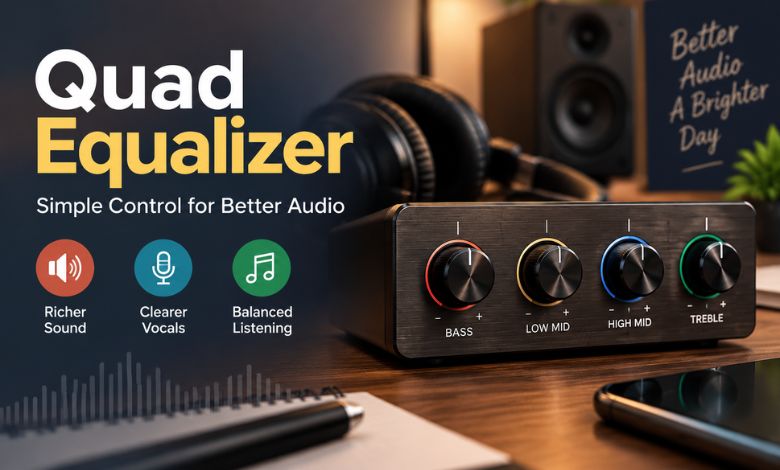
The word “quad” refers to four. In practical terms, a quad equalizer normally provides four adjustable frequency bands. The exact bands can differ from one system to another, but the idea remains the same. Users get four areas of control without having to deal with the large number of settings found on some professional audio equipment.
What Is a Quad Equalizer?
A quad equalizer is a type of four-band audio equalizer. It divides the sound spectrum into four sections and gives the user a control for each one.
These controls are often used to shape the overall character of music, speech, movies, games and other audio. Depending on the design, one control may affect low frequencies, another may work around the lower middle, a third may influence the upper middle, and the last may focus on higher frequencies.
There is no single layout that every quad equalizer follows. One product may choose different frequency points from another. Some systems also use different names for their controls.
So, rather than focusing too much on the numbers, it is better to understand what the bands are doing. They are giving you a practical way to make the audio feel warmer, clearer, deeper or brighter.
Why Equalization Matters
Audio is made up of many frequencies working together. When they are balanced well, a recording can sound natural and comfortable. When one area is too strong or too weak, the result may feel unbalanced.
This can happen for several reasons.
The recording itself may have a certain sound. Your headphones or speakers may emphasise particular frequencies. The room can also affect what you hear. In a car, the interior and road noise can change the listening experience even more.
A quad equalizer gives the listener some control over these differences.
Instead of accepting the sound exactly as it comes from the system, you can make adjustments that suit your equipment and your own preferences.
Getting to Know the Four Frequency Areas
The four bands are easier to understand when you think about how they change the feeling of a recording.
Low Frequencies
The lowest part of the spectrum is commonly associated with bass. This is where much of the weight and punch in music comes from.
Kick drums, bass guitars and deep electronic sounds can all be influenced by this area. Increasing it slightly can make a song feel fuller and more energetic.
The problem starts when the low end becomes too strong. Music may lose definition and begin to sound heavy or muddy. Bass should support the rest of the recording rather than cover it.
Lower Midrange
The lower midrange helps give many sounds their body. Voices, guitars, keyboards and other instruments can depend on this region for fullness.
Too little energy here may make a recording sound weak. Too much can create a thick or crowded feeling.
A small adjustment can be enough to change the overall character of the audio.
Upper Midrange
The upper middle part of the spectrum is strongly connected with clarity and presence. This is an important area for voices and many instruments.
When a singer seems buried behind the music, this range may be part of the problem. A careful adjustment can help a voice stand out without simply making it louder.
However, pushing the upper mids too hard can make some recordings sound aggressive. Subtle changes are usually easier on the ears.
High Frequencies
The highest band generally affects treble. It contributes to brightness, crispness and fine detail.
Increasing treble can make certain recordings feel more open. You may notice more detail in cymbals, percussion and vocal sounds.
There is a downside, though. Excessive treble can make audio feel sharp or tiring, especially when using headphones for long periods.
How a Quad Equalizer Changes the Listening Experience
An equalizer does not create new sounds. It changes the balance of sounds that are already present.
That can have a surprisingly strong effect.
For example, take a song with deep bass and a busy instrumental arrangement. A small reduction in the low end may create more space for the vocal. In another recording, a little extra high-frequency detail may make the music feel clearer.
These changes can be quite personal. There is no setting that everyone will prefer.
What sounds rich and powerful to one person might sound too bass-heavy to someone else. That is one reason equalizer settings are often a matter of taste.
Quad Equalizer in Car Audio
Car stereos are a common place to find four-band equalization.
Inside a vehicle, sound behaves differently from sound in a typical room. Speakers are positioned around the cabin, surfaces reflect audio, and traffic noise can hide some details.
A quad equalizer allows the driver to make adjustments based on the way the system actually sounds.
Someone might prefer stronger bass while listening to music. Another person may want the middle frequencies to be more noticeable because they spend a lot of time listening to radio programmes or podcasts.
The best settings depend on the vehicle and the speakers. A profile that works beautifully in one car may sound completely different in another.
Using It for Music
Music is probably the most obvious use for an equalizer.
Different styles of music have different characteristics. A bass-heavy electronic track may already contain a large amount of low-frequency energy. An acoustic recording may rely more heavily on the middle of the spectrum.
A quad equalizer can help listeners adapt the sound to the type of music they are hearing.
It can also help with personal preferences. Some people enjoy deep bass and a warm presentation. Others prefer a flatter, more balanced sound where vocals and instruments remain easy to separate.
There is no need to follow a strict rule. Listening is the most useful guide.
Can It Help With Speech?
Yes. Equalization is not limited to songs.
Podcasts, interviews, online videos and audiobooks can also benefit from careful frequency adjustments. Speech can sometimes sound dull, thin or difficult to follow because of the recording or playback system.
A small change in the relevant frequency area may help improve clarity.
The goal is not necessarily to make the voice louder. Instead, it is to make the voice easier to distinguish from the background and more comfortable to listen to.
For people who spend hours listening to spoken content, that can make a noticeable difference.
Quad Equalizer for Beginners
A four-band system is a reasonable place to start for someone who has never used an equalizer.
The first step is simple: put the controls in their neutral position and play something familiar.
Choose a song or recording that you know well. This gives you a reference point.
Then change one control slightly.
Listen carefully before making another adjustment. If you change all four controls at the same time, it becomes difficult to understand what happened. By working one band at a time, you can gradually learn how each section affects the sound.
After a little practice, the controls become much less mysterious.
Should You Increase Every Band?
This is one of the most common mistakes.
It may seem logical to raise everything because the sound becomes louder and more noticeable. But a louder signal is not automatically a better one.
Boosting every frequency can remove the natural balance of a recording. It may also make the audio feel crowded.
Sometimes a reduction is more useful than a boost. For example, lowering an overly strong frequency can reveal details that were already there.
Think of equalization as adjustment rather than enhancement at any cost.
How to Avoid an Unnatural Sound
The easiest way to keep a recording sounding natural is to avoid dramatic changes.
If you find yourself moving every slider toward the maximum position, step back and listen again.
Small adjustments are often enough.
It also helps to compare the modified sound with the original. Give yourself a few seconds to listen to both. This prevents a common problem where a louder version seems better simply because it is louder.
Your goal should be a sound that feels comfortable, not a sound that sounds impressive for five seconds.
Is a Quad Equalizer Good for Every Audio System?
A quad equalizer can be useful in many setups, but it cannot solve every audio problem.
If a speaker is damaged, an equalizer will not repair the hardware. If a recording is extremely poor, changing frequencies will not turn it into a studio-quality track.
What it can do is make frequency adjustments that better suit the equipment and the listener.
That makes it a useful feature, but not a substitute for good speakers, headphones or quality recordings.
Quad Equalizer vs. More Advanced Equalizers
The biggest difference between a four-band equalizer and a more advanced model is the level of control.
A professional equalizer may have many bands and offer detailed adjustments. That is helpful when working with complex recordings or trying to solve a very specific audio problem.
A quad equalizer takes a simpler approach.
Four controls are easier to understand, quicker to adjust and often enough for everyday listening. Someone who wants more detailed control can move to a 10-band or parametric equalizer later.
For casual users, however, extra controls are not always necessary.
What Makes a Good Setting?
There is no single answer because every listening situation is different.
Good settings usually have a few things in common. The sound should remain balanced, individual elements should not fight for attention, and listening should remain comfortable over time.
Start from neutral. Make a small change. Listen to familiar material. Then decide whether the result is actually better.
You may eventually create different profiles for music, podcasts and other content. That is perfectly normal.
The Role of Personal Preference
Audio has a technical side, but it also has a very personal side.
Two people can listen to the same headphones and prefer completely different settings. One may want a stronger low end, while another may prefer vocals and instruments to sound more forward.
Neither preference is automatically right or wrong.
The purpose of a quad equalizer is to give you the freedom to make those choices. It allows the listener to move away from a fixed sound profile and find something that feels better.
Conclusion
A quad equalizer is a simple way to gain more control over the sound you hear. With four adjustable bands, it gives users room to shape bass, midrange and treble without the complexity of a highly advanced professional equalizer.
That simplicity is also part of its appeal. You do not need extensive audio knowledge to start using one. A little patience, familiar music and small adjustments can teach you a lot about how different frequencies affect what you hear.
Whether it is built into a car stereo, included in audio software or used with another sound system, a quad equalizer is ultimately a tool for personalising audio.
The best setting is not the one with the highest bass or the brightest treble. It is the setting that makes the recording sound balanced, clear and comfortable to your ears.
(FAQs)
What is a quad equalizer?
A quad equalizer is an audio equalizer with four adjustable frequency bands. It allows users to change different parts of the sound spectrum instead of adjusting the whole audio signal together.
What does a quad equalizer control?
The four controls normally affect different areas such as bass, lower midrange, upper midrange and treble. The exact frequency ranges depend on the device or software.
Is a quad equalizer useful for headphones?
Yes. It can be used to adjust the sound of headphones according to personal preference. Small changes may help with bass, vocal clarity or treble balance.
Can a quad equalizer improve vocals?
It can help make vocals more noticeable by adjusting relevant frequency areas. The best approach is usually a small change rather than a large boost.
What is the best quad equalizer setting?
There is no universal best setting. The right balance depends on the recording, speakers or headphones, listening environment and personal taste.