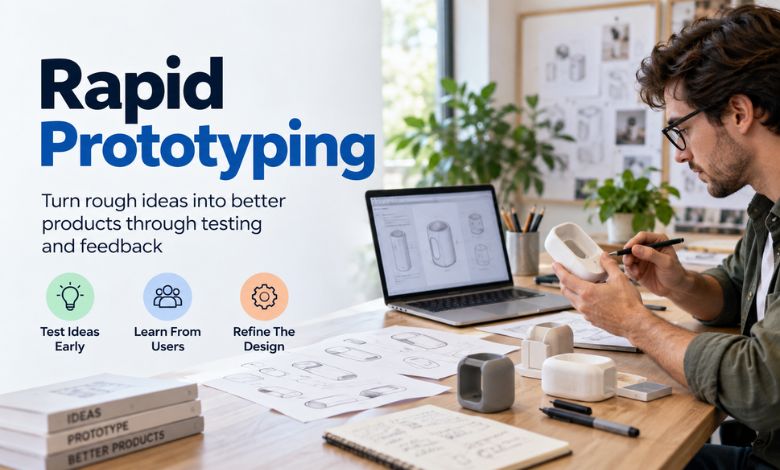
Building a new product is rarely as simple as it looks from the outside. A team can spend weeks discussing an idea, creating plans and imagining how customers will use it. Then, when the first real version appears, something unexpected happens. People may struggle with a feature, ignore an important button or discover that the product does not solve the problem in the way everyone expected.
That is where rapid prototyping comes in.
Instead of waiting until a product is fully developed, teams create an early version and put it to the test. It can be rough. It can be incomplete. It can even look nothing like the finished product. What matters is that it gives the team a chance to learn before the project becomes too expensive or difficult to change.
This simple idea has become an important part of software development, product design, engineering, website creation and business innovation. In many cases, the first prototype is less about proving an idea is perfect and more about finding out where it needs work.
The Real Idea Behind Rapid Prototyping
At its heart, rapid prototyping is about reducing guesswork.
When people talk about a new product, they naturally make assumptions. They assume customers will understand the interface. They assume a certain feature will be useful. They assume a physical product will be comfortable to hold or easy to operate.
Sometimes those assumptions are right. Sometimes they are not.
A prototype gives the team a way to check.
Rather than asking people to imagine what a product might be like, the team gives them something they can actually interact with. That small difference can change the quality of the feedback completely.
A person may say an idea sounds good when it is explained to them. Give them a prototype, and they may immediately point out something that does not make sense.
That is useful information.
You Do Not Need a Perfect Prototype
One of the biggest misunderstandings about prototyping is that an early model needs to look polished.
It does not.
A designer might draw a few screens on paper and use those sketches to understand how someone moves through an app. Another team might create a very basic digital mock-up with plain boxes, simple text and almost no visual decoration.
That can be enough.
The point is to test the part of the product that is still uncertain.
There is little value in spending hours perfecting a logo when the team has not yet decided whether the overall layout works.
Keeping early prototypes simple also makes it easier to throw away a weak idea and start again.
A Small Experiment Can Prevent a Big Mistake
Imagine a company wants to build a new online marketplace.
The business plan looks promising, so the team starts thinking about search tools, seller accounts, payment systems, reviews, notifications and personalised recommendations.
It would be possible to start developing all of these things immediately.
But there is a better question to ask first: can users actually move through the basic buying process without getting confused?
A prototype can answer that question.
Users can be shown how they would search for an item, open a product page, add it to a basket and complete a purchase. If they struggle somewhere along the way, the team has found a problem before building the whole system around it.
That is the practical value of rapid prototyping. A small experiment can stop a much bigger mistake from happening later.
What Can a Prototype Look Like?
There is no single format.
A very early concept may only need a paper sketch. This is especially useful when a team is discussing different ideas and wants to compare them quickly.
A wireframe is a more organised option. It shows the structure of a website or application without necessarily including final colours, images or branding.
An interactive prototype is more realistic. Users can click buttons, move between screens and complete simple tasks. It can give a strong impression of how a finished product might feel without requiring the entire system to be built.
For physical products, a prototype may be a simple model or a more detailed sample made with modern manufacturing methods.
The best choice depends on what the team needs to learn.
Why User Behaviour Matters So Much
There is a difference between what people say and what they actually do.
That is important during testing.
Someone may tell a design team that a website looks easy to use. But when asked to find a particular piece of information, they may click three wrong buttons first.
That moment tells the team something valuable.
Designers and developers spend so much time with their own products that certain details become obvious to them. A new user does not have that background.
Watching an unfamiliar person use a prototype can therefore reveal issues that internal discussions never uncovered.
Sometimes the problem is tiny. Sometimes it points to a much bigger issue with the entire user journey.
Rapid Prototyping in Software Projects
Software is particularly suited to this method because digital products can be difficult to judge from descriptions alone.
Consider a new mobile health or fitness app. The development team may know exactly how they want users to register, choose a plan, track progress and review their results.
But does the process actually feel natural?
A prototype can help answer that before the developers spend months creating the full application.
It can also help teams decide which features deserve attention. Perhaps users love one part of the concept but rarely use another. Maybe an important task takes too many steps.
Learning this early allows the development team to focus its effort where it matters.
Physical Products Tell a Different Story
With physical products, testing has another advantage: people can feel the difference between a drawing and a real object.
A new pair of headphones may look attractive on a screen but feel uncomfortable after ten minutes. A handheld device might have a clever design but place its main controls in an awkward position.
A physical prototype makes these problems easier to notice.
It can also uncover issues involving size, weight, balance, assembly and durability.
This is why prototypes can be valuable long before a manufacturer is ready for full-scale production. There is a big difference between knowing that a design looks right and knowing that it works in someone’s hands.
The Importance of Honest Feedback
A prototype works best when the team is willing to hear things it may not like.
That can be difficult.
People often become attached to ideas they helped create. A negative comment about the prototype can feel like criticism of the team’s work.
But the purpose of testing is not to receive compliments.
Suppose five users struggle with the same part of an application. Ignoring the issue because the team likes the current design does not make the problem disappear.
Good teams treat feedback as evidence.
They look for repeated patterns, separate genuine usability problems from personal preferences and then decide what deserves attention.
What Makes Rapid Prototyping Different From Ordinary Development?
Traditional product development can involve long periods of planning and building before something is put in front of users.
Prototyping brings testing much closer to the beginning.
That means teams can make decisions while there is still plenty of room to change direction.
A developer can replace a complicated workflow. A designer can move a feature. An engineer can alter the shape of a component.
None of those changes necessarily require the kind of disruption that might happen after the finished product has already been launched.
The method therefore supports a more flexible way of working.
It Can Save More Than Just Money
People often talk about the cost savings associated with prototyping, and that is certainly important.
But the benefit can be much broader.
Time is saved because teams spend less effort developing features that may later be removed. Communication improves because everyone has something concrete to discuss. Decisions become easier because they are based on real testing rather than pure speculation.
There is also a psychological advantage.
A team that knows it can test an idea early may feel more comfortable experimenting. It becomes less frightening to try something unusual because failure at the prototype stage is manageable.
That can lead to better ideas.
Where Teams Can Go Wrong
Rapid prototyping is not automatically successful.
Sometimes people make the prototype too complicated. They add unnecessary features, spend too much time on visual details and turn a quick test into a major development project.
Another mistake is failing to define the purpose of the test.
If the team does not know what it wants to learn, it can collect a lot of feedback without gaining much clarity.
There is also the danger of changing things endlessly.
Testing should lead to decisions. A project cannot stay in prototype mode forever.
At some point, the team needs to look at what it has learned and decide whether the product is ready for more serious development.
Prototyping Does Not Mean Ignoring Technical Reality
A prototype can show that users like an idea, but that does not automatically mean the product is technically practical.
A feature might be difficult to build. A physical component might be too expensive to manufacture. A service could create operational problems that users never see.
This is why good development combines different kinds of testing.
A prototype can help answer questions about usability and concept. Technical work can determine whether the idea can be built effectively. Business analysis can help decide whether it makes financial sense.
Together, these perspectives create a much clearer picture.
The Role of Modern Tools
The tools available today have made prototyping considerably easier.
Digital design platforms allow teams to create interfaces that users can click through without requiring a fully developed application.
For physical design, computer-based modelling and 3D printing can make it possible to produce and examine different versions of an object without setting up a complete manufacturing process.
Collaboration tools also mean a prototype can be reviewed by people who are working in different offices or even different countries.
Artificial intelligence is adding another layer to the process by helping teams explore concepts and generate early design ideas more quickly.
Still, the tools are only part of the story. The important thing is what the team learns from using them.
When Is Rapid Prototyping Worth Using?
It is particularly valuable when there is uncertainty.
If a team knows exactly what it is building and has already tested the idea thoroughly, a large prototype may not be necessary.
But when important questions remain unanswered, an early model can be extremely useful.
This is true for a startup exploring a new service, a software company developing an unfamiliar feature or an engineer working on a new physical design.
The more expensive a mistake would be, the more useful early testing can become.
The Process Can Change the Original Idea
Perhaps one of the most interesting things about prototyping is that the final product may end up being very different from the original concept.
That is not necessarily a failure.
A team might discover that users want fewer features instead of more. A product may become simpler. A complicated workflow could turn into a much shorter one.
Sometimes the best result is not proving the original idea correct. It is discovering a better idea.
That is why prototypes should be treated as learning tools rather than promises about what the final product will look like.
What the Future May Look Like
The basic principle behind prototyping is unlikely to disappear.
As technology becomes more accessible, creating an early version of a product will probably become faster and easier. Designers may be able to explore more variations before choosing a direction. Engineers may be able to produce physical samples with less material and time. Software teams may test interactions before writing large amounts of code.
But no tool can replace one essential part of the process: putting the idea in front of people and paying attention to their response.
Technology can speed up the prototype.
Human feedback still gives it meaning.
Conclusion
Rapid prototyping is ultimately a practical way of dealing with uncertainty.
Instead of assuming an idea will work and discovering the truth after a large investment, teams can create a smaller version and learn first. The prototype might expose an obvious problem, confirm a useful feature or completely change the direction of the project.
None of those outcomes is wasted effort.
The real value is that the team learns while the product is still flexible.
In a world where businesses are constantly trying to build better websites, applications, services and physical products, that ability to test early can be extremely valuable. A rough first attempt is often much more useful than a perfect-looking product that nobody has tested.
(FAQs)
What is rapid prototyping in simple words?
Rapid prototyping means making an early version of a product quickly so that its idea, design or main features can be tested before full development.
Does a prototype need to be fully working?
No. A prototype only needs enough functionality or detail to answer the question being tested. Some prototypes are interactive, while others are simple sketches or physical models.
What is the main purpose of rapid prototyping?
The main purpose is to learn early. It helps teams discover problems, understand users and make changes before the final product becomes difficult or expensive to change.
Is rapid prototyping useful for small businesses?
Yes. Small businesses and startups can use simple prototypes to test websites, services, apps and product ideas without committing a large budget at the beginning.
Can rapid prototyping change the final product?
Absolutely. Testing may reveal that customers need different features, a simpler process or a completely different approach. In many cases, those discoveries lead to a stronger final product.