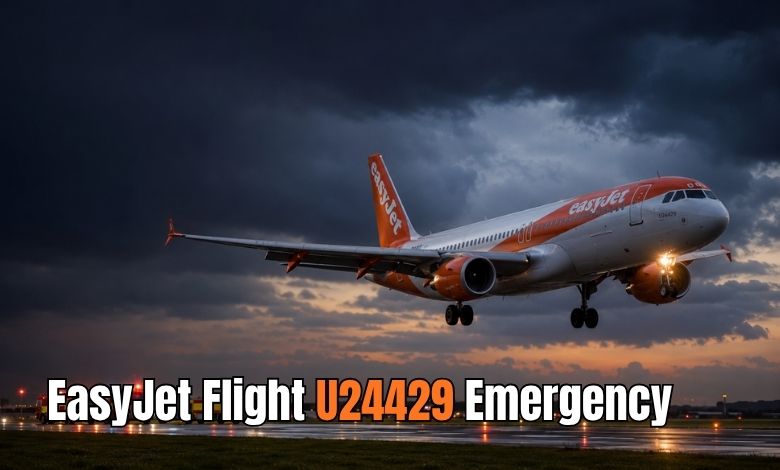
The EasyJet Flight U24429 emergency took place on 22 August 2025 during a scheduled journey from Lyon, France, to Porto, Portugal. What began as a normal European flight changed shortly after take-off when the behaviour of a passenger created a serious security concern inside the cabin. The flight returned to Lyon Saint-Exupéry Airport, where police met the aircraft and removed the passenger. EasyJet later confirmed that the flight was able to continue to Porto after the situation had been brought under control.
The incident received attention because the reason for the return was not an engine fault, bad weather or another common operational problem. Instead, authorities said a passenger attempted to gain access to the cockpit. Other passengers helped restrain the individual until the aircraft was safely back on the ground. The event showed how quickly an ordinary commercial journey can change when cabin security becomes a concern.
What Happened on EasyJet Flight U24429?
Flight U24429 had departed from Lyon for Porto on the evening of 22 August 2025. Soon after take-off, a passenger reportedly became distressed and attempted to enter the cockpit area. French police later said that other passengers subdued and restrained him until the aircraft returned to Lyon.
For an airline crew, an attempt to interfere with the cockpit is treated seriously regardless of the reason behind the behaviour. The pilots therefore had a clear reason to end the original journey and return to an airport where police and medical assistance could be available. The aircraft landed safely at Lyon, allowing authorities to take control of the situation.
EasyJet confirmed that flight EJU4429, another operating reference for U24429, returned to Lyon shortly after departure because of a passenger’s behaviour. Police met the flight when it arrived. Once the passenger had been removed, the service later continued towards Porto.
Why Did the EasyJet Flight U24429 Emergency Happen?
The easyjet flight u24429 emergency was connected to passenger behaviour rather than a reported technical failure of the aircraft. French police said the passenger was a 26-year-old Portuguese national. Medical examinations later indicated that he was experiencing airsickness and delirium, and he was admitted to a French hospital.
This detail is important because early descriptions of an aviation emergency can sometimes make the situation appear different from what authorities later establish. In this case, the available reporting points to a medical and behavioural episode that developed into a security concern because the passenger attempted to reach the cockpit.
Whatever the underlying reason, the crew could not simply ignore behaviour involving the flight deck. Cockpit access is tightly controlled on commercial aircraft, and an attempt to interfere with that secure area requires an immediate response.
How Passengers Helped Control the Situation
One of the most notable parts of the incident was the response from people travelling on the aircraft. Police said other passengers subdued and restrained the man until the plane landed. Their intervention helped prevent the situation from developing further while the pilots concentrated on returning the aircraft safely to Lyon.
Cabin disturbances can be difficult because flight crew members are working in a confined environment thousands of feet above the ground. There is no immediate access to police during flight, so cabin crew have to follow established procedures while keeping other travellers as safe and calm as possible. In unusual cases, assistance from passengers may also help control someone whose behaviour creates an immediate risk.
The U24429 incident ended without the reported cockpit intrusion developing into a larger security event. Once the aircraft landed, responsibility could be transferred to police and medical professionals.
Why Returning to Lyon Was the Safest Decision
Returning to Lyon Saint-Exupéry Airport allowed the crew to deal with the incident at the airport from which the aircraft had recently departed. This meant that police and other ground services could be ready when the plane arrived.
Continuing towards Porto while a serious passenger disturbance remained unresolved would have kept the aircraft airborne for longer. Returning instead reduced the time before authorities could take control of the situation. The decision also allowed the crew to restore normal conditions before attempting to continue the scheduled journey.
Aviation tracking reports said the aircraft involved was an Airbus A320 and that an emergency was declared during the return. The safe landing demonstrated the purpose of emergency procedures: they give flight crews the flexibility to change their plans quickly when circumstances aboard an aircraft make continuing the original route unsuitable.
What Happened After the Aircraft Landed?
Police were waiting when U24429 returned to Lyon. The disruptive passenger was removed from the aircraft, examined and later admitted to hospital after medical checks indicated airsickness and delirium.
For the remaining travellers, the disruption did not permanently end their journey. EasyJet said that once police had removed the passenger, the flight continued to Porto. This is an important part of the story because it shows that the aircraft itself was not reported by the airline as being responsible for the return.
The incident therefore became primarily a passenger-security and medical event, rather than an aircraft malfunction. Once the immediate problem had been dealt with, the airline was able to resume the service.
Why Cockpit Security Is Treated So Seriously
The cockpit is one of the most restricted areas on any passenger aircraft. Pilots are responsible for navigation, communication, aircraft systems and major safety decisions, so preventing unauthorised access to the flight deck is an essential part of modern aviation security.
A passenger approaching or attempting to enter the cockpit can create several concerns at once. Cabin crew have to assess the person’s behaviour, protect other travellers, communicate with the pilots and prevent access to sensitive areas of the aircraft. At the same time, the flight crew must decide whether the aircraft should continue, divert or return to its departure airport.
The EasyJet Flight U24429 emergency illustrates why these procedures exist. Even where the behaviour may ultimately be linked to a medical condition, the immediate situation has to be managed according to the level of risk presented at that moment.
What the U24429 Incident Shows About Airline Emergency Procedures
Not every aviation emergency involves smoke, engine trouble or severe weather. Passenger behaviour can also force a flight crew to change course. The Lyon-to-Porto incident is an example of an emergency that developed entirely inside the cabin.
Several layers of response were involved. Passengers helped restrain the individual, the airline crew managed the aircraft and cabin, the pilots returned to Lyon, and police took over after landing. Medical professionals then became involved after the passenger was examined.
The event also shows why pilots may choose the safest available option rather than attempting to continue a scheduled flight. A diversion or return can cause delays and inconvenience, but passenger and crew safety takes priority over reaching the destination on time.
Was EasyJet Flight U24429 Safe to Continue Afterwards?
EasyJet’s statement indicates that after police removed the passenger, the flight was able to continue to Porto. That is significant because it distinguishes this event from emergencies caused by serious aircraft damage or a mechanical defect that prevents further operation.
There is no indication in the airline’s published statement cited by major news outlets that a technical problem caused the return. The central issue was the behaviour of the passenger on board. After that individual was removed and the immediate security concern ended, the journey resumed.
Conclusion
The EasyJet Flight U24429 emergency on 22 August 2025 turned a routine journey from Lyon to Porto into an unexpected in-flight security incident. A passenger attempted to gain access to the cockpit and was restrained by other passengers while the aircraft returned to Lyon Saint-Exupéry Airport. Police met the flight, removed the individual and authorities later said medical examinations indicated that he was experiencing airsickness and delirium.
Most importantly, the aircraft returned safely and the remaining journey later continued to Porto. The incident provides a clear example of how crew training, cockpit security, passenger cooperation and rapid decision-making can work together when an unexpected situation develops in the air.
(FAQs)
What happened during the EasyJet Flight U24429 emergency?
The flight returned to Lyon shortly after take-off because of the behaviour of a passenger who attempted to enter the cockpit. Other passengers helped restrain him until the aircraft landed.
Where was EasyJet Flight U24429 travelling?
Flight U24429 was operating between Lyon, France, and Porto, Portugal when the incident occurred on 22 August 2025.
Was the emergency caused by a technical problem?
Available reports and EasyJet’s statement identify the reason for the return as passenger behaviour, rather than a technical fault with the aircraft.
What happened to the passenger after landing?
French police said the 26-year-old Portuguese passenger underwent medical examinations that indicated airsickness and delirium. He was subsequently admitted to a hospital in France.
Did EasyJet Flight U24429 eventually reach Porto?
Yes. EasyJet said the flight continued to Porto after police removed the passenger from the aircraft in Lyon.