Space Force Orbital Warship Carrier: The Truth Behind the Giant Military Spacecraft Idea

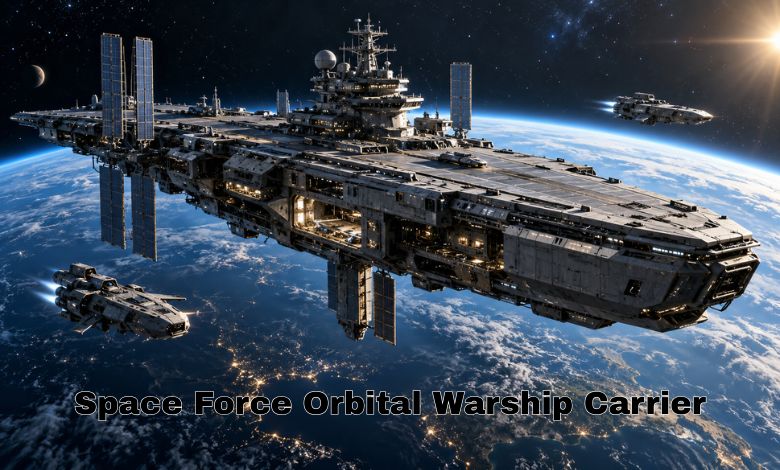
The name Space Force Orbital Warship Carrier makes it sound as though a giant American battleship is already circling Earth. That is not the case. No official public record confirms that the United States Space Force operates a large carrier filled with smaller military spacecraft.
The idea is still worth discussing because it is linked to a real change in defence planning. Military forces now depend on satellites for navigation, communication, weather reports, intelligence, and missile warnings. These satellites need to remain available during both normal operations and emergencies.
An orbital carrier is therefore imagined as a permanent support base in space. It might carry equipment, release smaller vehicles, monitor nearby objects, and help maintain important satellites. Some parts of that idea are technically possible, while others remain extremely difficult and expensive.
The Term Is Not an Official Space Force Project Name
The first point to understand is that Space Force Orbital Warship Carrier is not the publicly confirmed name of a Space Force spacecraft or building programme. The phrase is mostly found in fictional writing, online concept images, defence discussions, and reports about technology that may appear in the future.
The word “carrier” comes from the idea of a naval aircraft carrier. At sea, one large ship carries aircraft, maintenance equipment, fuel, supplies, and a command team. It acts as a moving base that can support several operations without depending on a nearby airport.
An orbital carrier would follow the same general idea, but it would face completely different conditions. There is no air in space, and a spacecraft cannot sail freely in any direction. It must travel along a calculated orbit. Moving to another location requires time, planning, and fuel.
For this reason, the popular picture of a carrier quickly flying from one satellite to another is not realistic. Any real design would work more like a slowly moving service station than a fast battleship.
What the Space Force Actually Does
The United States Space Force was established to manage military responsibilities connected with space. Much of its work is performed through satellites, ground stations, communication networks, launch sites, and control teams rather than large crewed spacecraft.
One major duty involves missile warning. Satellites equipped with specialised sensors can detect the heat created during a missile launch. That information can then be sent to military commanders and national defence authorities.
The service also supports satellite communication. Military units may be operating thousands of miles apart, so secure communication systems are needed to share instructions and information. Space-based systems help maintain those connections.
Navigation is another important responsibility. GPS satellites provide location and timing information used by aircraft, ships, vehicles, weapons systems, emergency teams, businesses, and ordinary drivers. A problem affecting GPS would be noticed far beyond military bases.
The Space Force also watches objects travelling around Earth. This work helps identify active satellites, unused spacecraft, rocket parts, and dangerous debris. None of these operations require a fictional-style warship, but they explain why the protection of orbit has become a serious subject.
Why People Believe an Orbital Carrier May Be Needed
A modern military can lose important abilities if its satellites are disrupted. Communication may become slower, navigation may be less accurate, and commanders may have difficulty receiving early warnings. Because so many services depend on orbit, countries are looking for ways to make their space systems harder to damage.
An orbital carrier is attractive in theory because it could place several useful tools in one location. It might carry spare components, communication equipment, cameras, tracking sensors, and small inspection vehicles. When a nearby satellite developed a problem, the carrier could send a robotic craft to examine it.
The same platform might also help military teams understand what is happening in a busy part of orbit. Its sensors could observe unusual movements and pass information to ground controllers. Smaller craft could then be sent closer if a detailed inspection was required.
This does not mean every mission would involve fighting. Maintenance, observation, transport, and communication could be more valuable than weapons. In practice, a carrier’s everyday work might resemble that of a repair depot and control centre.
How Engineers Might Design Such a Spacecraft
A realistic carrier would probably be assembled from several sections. Launching the complete structure on one rocket would be difficult because rockets have strict limits on size and weight. Separate parts could be launched one at a time and joined together in orbit.
The main body might contain computers, storage areas, communication equipment, fuel tanks, cameras, and docking points. Large solar panels could generate electricity. Batteries would keep essential equipment working when the spacecraft moved into Earth’s shadow.
Robotic arms might handle equipment outside the platform. They could move cargo, position replacement parts, or assist a smaller vehicle during docking. Robots would be useful because sending people outside a spacecraft is dangerous and requires lengthy preparation.
The carrier might release small unmanned vehicles for short missions. These craft could inspect another satellite, photograph damage, examine an unknown object, or carry tools to a nearby location. After completing the work, they could return to the platform for checking and reuse.
A permanent human crew is less likely in an early design. People need oxygen, water, food, sleeping space, medical support, waste systems, and protection from radiation. Removing the crew would reduce the platform’s weight and lower the risk of losing lives if something went wrong.
The Biggest Problems Would Begin Before Launch
A large orbital platform would be extremely expensive. The cost would include research, testing, rocket launches, ground facilities, software, staff, security systems, and years of maintenance. Even a small design mistake could lead to serious delays.
Construction in orbit would also be demanding. Every section would need to connect correctly after surviving launch vibration and temperature changes. Engineers could not simply walk around the structure with ordinary tools if a part failed to fit.
Fuel would create another limit. A heavy carrier would require a great deal of energy to change its orbit. It could not travel across space in the way a ship moves across the sea. Most of the time, it would follow the same path around Earth and make only carefully planned adjustments.
There is also the danger of space debris. Thousands of inactive objects and fragments are already travelling around the planet. A small piece can damage equipment because it may be moving at several kilometres per second. A huge platform would present a larger surface that debris could strike.
Ageing would become a problem as well. Cameras, computers, batteries, and communication equipment improve quickly. A carrier taking many years to build might contain outdated systems by the time it was completed. Replacing those systems in orbit would add further cost.
One Large Platform Would Be Easy to Track
A large carrier might combine many useful services, but that would also make it a valuable target. If one accident or attack disabled the platform, the military could lose communication, observation, storage, and repair support at the same time.
Its size would make it difficult to hide. Other countries would be able to track its orbit and study its movements. Even if the carrier were built for protection, rival governments might believe it could be used for an attack.
That suspicion could encourage an arms race. Countries might begin developing their own carriers or new methods of damaging large spacecraft. A project intended to improve security could therefore create greater tension.
Computer security would be another concern. The carrier would depend on software and signals sent from Earth. An attacker might try to block those signals, send false information, or enter the control network. Protecting its computers would be as important as protecting its outer structure.
Smaller Satellites May Be a Better Choice
Military space programmes increasingly use groups of smaller satellites. This approach spreads important services across many separate spacecraft. If one satellite fails, the rest of the network may continue working.
Small satellites are normally easier to launch and replace. They can also be improved in stages as new technology becomes available. A large carrier would take longer to design and would be more difficult to update.
A network does not have the dramatic appearance of a warship, but it may be more practical. Several satellites working together can provide communication, tracking, and observation without placing every system on one vulnerable platform.
The future may include a mixture of both ideas. Smaller satellites could form the main network, while one or more unmanned servicing vehicles provide fuel, repairs, or transport. These support vehicles might perform some carrier duties without becoming giant orbital battleships.
Does the X-37B Prove a Carrier Already Exists?
The X-37B is a real unmanned spaceplane used by the American military for testing and research. It can remain in orbit for an extended mission and then return to Earth. Some details of its work are not made public, which naturally leads to speculation.
However, the X-37B is not an orbital warship carrier. It is far smaller than the platform described by that name, and it does not publicly carry a fleet of smaller military vehicles.
The X-37B shows that reusable spacecraft can support long missions. Technology tested through such programmes may influence later vehicles, but it is not evidence that a giant carrier is secretly operating above Earth.
Conclusion
The Space Force Orbital Warship Carrier is an interesting idea built around a real military concern: protecting the satellites that support communication, navigation, intelligence, and missile warnings. An orbital platform might one day carry robotic vehicles, spare equipment, sensors, and communication systems.
No public evidence currently confirms that the Space Force operates such a carrier. Launch weight, cost, fuel, maintenance, debris, computer security, and political tension all stand in the way. A smaller unmanned service station may become possible before anything resembling a space warship appears.
For now, the carrier belongs to future planning and informed imagination. Claims presenting it as an active military spacecraft should not be accepted without clear and reliable official proof.
(FAQs)
Is the Space Force Orbital Warship Carrier real?
No publicly confirmed orbital warship carrier is currently operated by the United States Space Force. The term describes a possible future concept.
What would the carrier transport?
It might transport small unmanned spacecraft, repair tools, fuel, communication equipment, sensors, replacement parts, and other mission supplies.
Would the carrier have weapons?
No official design has been announced, so its equipment is unknown. Most descriptions involving weapons come from fiction or unofficial speculation.
Is the X-37B connected to the carrier concept?
The X-37B may help test technology useful for future spacecraft, but it is not a carrier and does not publicly perform that role.
Could an orbital carrier be built in the future?
A carrier-like support platform may become possible as rockets, robotics, and orbital servicing improve. There is no confirmed date for such a project.