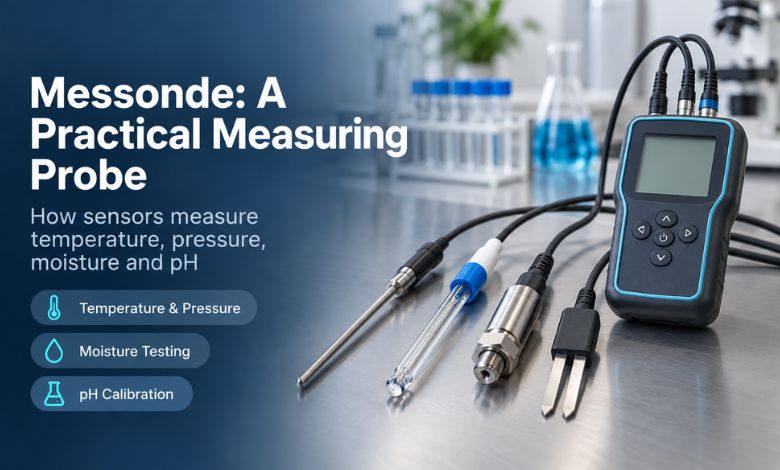
Messonde is one of those words that can stop a reader halfway through a product description. It sounds technical, yet it does not point to one well-known machine or recognised English product category. In most cases, the word is being used for a measuring probe: the part of an instrument that senses temperature, pressure, moisture, pH, gas, or another condition.
The spelling may come from Messsonde, a German term for a measurement probe. Sometimes one “s” disappears in translated listings, old labels, or online product records. That small spelling change can make the word look like the name of a new device when it is really describing a familiar piece of measuring equipment.
There is no single Messonde that performs every test. Its job depends on what is fitted inside it, where it is placed, and which instrument receives its signal. Understanding that difference is more useful than memorising one short definition.
Messonde Is a General Term, Not One Product
A Messonde should not be treated as a particular brand or model. The safest way to understand it is to think of it as the “listening” part of a measuring system. It sits close to the thing being checked, notices a change, and sends that information somewhere it can be read.
Take a digital food thermometer. The pointed metal section goes into the food and reacts to heat. The screen in the handle turns that reaction into a temperature. In this example, the pointed section is the probe. The same arrangement appears in factory machines, water-testing equipment, heating systems, laboratory instruments, and many ordinary appliances.
The term alone does not tell a buyer enough. A listing may call an item a Messonde, but that description does not reveal what it measures, how accurate it is, or whether it will connect to existing equipment. The model number and technical details are much more important than the name printed at the top of the page.
If the word appears on an older German machine, searching for “Messsonde” together with the manufacturer’s name may produce clearer results. It may also help when trying to locate a manual or replacement part.
What Happens When a Probe Takes a Reading?
A measurement starts at the sensing tip. Inside that part is a material or component that reacts to a certain condition. Heat, pressure, moisture, light, or chemical changes can alter its electrical behaviour. The rest of the instrument reads that change and turns it into a value people can understand.
A temperature probe, for instance, may produce a different resistance or voltage as it becomes warmer. A pressure probe may contain a thin part that moves slightly when a liquid or gas pushes against it. A pH electrode responds to conditions in a liquid and sends a small electrical signal to the meter.
The figure on the display is therefore the final step, not the measurement itself. Before the number appears, the probe has detected a change, created a signal, and passed it to the reading unit. Any problem during that journey can affect the result. A dirty tip, damaged cable, weak connection, or incorrect setting may all lead to a doubtful reading.
Some systems do more than show numbers. A probe fitted inside a boiler can tell the controls when the water has reached the chosen temperature. A sensor in a storage tank can warn that the liquid is close to the top. On a production line, a temperature or pressure change may cause the machinery to slow down or stop. The probe is small, but the decision based on its reading can be important.
The Different Jobs a Messonde May Perform
There are many types of measuring probes because no single design can handle every job. Temperature probes are among the most common. They are used in cooking equipment, refrigerators, laboratories, heating systems, engines, and industrial machines. Some touch the object directly, while infrared equipment can check certain surfaces from a distance.
Pressure probes are found in pipes, pumps, ventilation systems, boilers, and hydraulic machinery. They help operators see whether the pressure is normal or beginning to move outside the expected range. An unusual reading may be the first sign of a blockage, a leak, or a failing component.
A pH probe is used with liquids. It can help test drinking water, swimming pools, aquarium water, soil solutions, and materials used in food or chemical work. These probes are more delicate than they may appear. If the glass sensing part dries out, becomes coated, or is handled roughly, the reading can become slow or unreliable.
Moisture probes also vary. A gardener may use a basic version to check soil in a plant pot, while a farmer may take readings across a large field. Other models are made for timber, concrete, plaster, grain, or stored goods. The word “moisture” is shared, but the tools are not automatically interchangeable.
Gas probes are designed around the gas they need to detect. A carbon monoxide sensor has a different task from one made for oxygen or carbon dioxide. Using the wrong sensor can create a false sense of safety, so the intended gas and measuring range must be confirmed before use.
Where These Measuring Probes Are Found
In laboratories, probes allow people to watch conditions while an experiment is taking place. A liquid may look unchanged even though its temperature or pH has moved. Without a measurement, that change could easily be missed. Recorded readings also make it possible to compare one test with another.
Factories use similar tools on a larger scale. A worker cannot stand beside every pipe, tank, motor, and production stage throughout the day. Fixed sensors do that watching instead. They send readings to a control panel, where changes can be noticed before a machine fails or a batch of material is spoiled.
Environmental teams use portable and fixed probes to study water, soil, and air. A probe can be lowered into a river, placed in the ground, or left at a monitoring station. The reading only describes the condition at that place and time, so researchers often collect several measurements rather than relying on one result.
Farmers use measurements to support practical judgement. Soil may look dry at the surface while remaining wet below, or it may appear healthy after a brief shower even though deeper roots still need water. A suitable moisture probe gives extra information, although it does not replace knowledge of the land.
Similar sensing parts are hidden inside household appliances. An oven checks heat, a fridge controls cooling, and a thermostat responds to room temperature. Most owners never see these components unless something goes wrong, yet they quietly help the appliance do its everyday job.
Why a Messonde Can Give the Wrong Result
People often trust a digital figure because it looks exact. A screen showing 24.6 appears more convincing than one showing 25, but an extra decimal place does not prove that the device is correct. Accuracy depends on the probe, its condition, its position, and the way it is being used.
Location is a common source of error. A room sensor placed beside a sunny window may give a higher temperature than the centre of the room. A soil probe used in one unusually damp patch cannot represent an entire garden. A pH electrode that is only partly immersed may produce an unstable value.
Time matters as well. Some probes respond almost at once, while others need a short period to settle. Moving the probe too quickly or recording the first figure on the display may produce a poor result. The user should follow the waiting time given in the instructions.
Physical condition also deserves attention. Cracked covers, bent connectors, chemical deposits, worn cables, and damaged sensing tips can all cause trouble. A probe that has been dropped may still turn on, but that does not mean it is measuring correctly.
When the reading affects health, safety, scientific work, or product quality, guessing is not acceptable. The instrument should be checked against a known reference or tested by someone qualified to assess it.
Choosing and Caring for the Right Probe
Before buying a Messonde, decide exactly what needs to be measured and under which conditions. A temperature probe intended for a living room will not be suitable for a hot industrial oven. A moisture tool made for timber may not provide useful soil readings.
The working range is one of the first details to check. Accuracy, response time, probe length, cable length, outer material, connection type, and protection against water or dust may also matter. If the probe will connect to an existing meter, the plug and signal must match that instrument.
Cleaning and storage depend on the design. A plain metal probe may only need careful wiping, while a pH electrode often requires a proper storage liquid. Harsh cleaning products should not be used unless the maker recommends them. What works on one sensor can ruin another.
Calibration is another practical concern. It means comparing the instrument with a trusted reference to see whether the reading is still within an accepted limit. The required schedule depends on how the probe is used. A factory, laboratory, or healthcare setting may need formal records, while a simple household tool may only require occasional checking.
Good care does not make a poor-quality sensor accurate, but it helps a suitable one continue working as expected. Keeping the probe clean, protecting its tip, and avoiding sharp bends in the cable can prevent many everyday problems.
Conclusion
Messonde is not the name of one universal invention. It is an uncommon spelling usually linked with a measuring probe, possibly through the German word Messsonde. The exact meaning changes with the equipment around it.
One probe may check temperature, another may measure pressure, and another may test pH or moisture. What joins them is their basic purpose: they sense a condition and pass the result to an instrument that can display, store, or act on it.
Anyone dealing with a Messonde should look beyond the label. The intended measurement, range, accuracy, connection, material, and care instructions provide the information that really matters.
(FAQs)
What is a Messonde?
A Messonde is generally understood to be a measuring probe or sensor. It gathers information about a physical or chemical condition and passes the signal to another instrument.
Is Messonde the correct spelling?
Messonde appears in some listings and records, but Messsonde is the more familiar German technical spelling. The shortened form may result from translation, typing, or older product labelling.
Can every Messonde measure temperature?
No. Only a probe built for temperature can perform that job. Other probes may measure pressure, pH, moisture, gas, liquid level, or physical size.
Why does a probe need calibration?
Calibration checks whether the reading agrees with a trusted reference. It can reveal drift or error before the measurement is used for an important decision.
Can a damaged Messonde still show a reading?
Yes, but that reading may be wrong. A working display does not prove that the sensing tip, cable, or connection is in good condition.