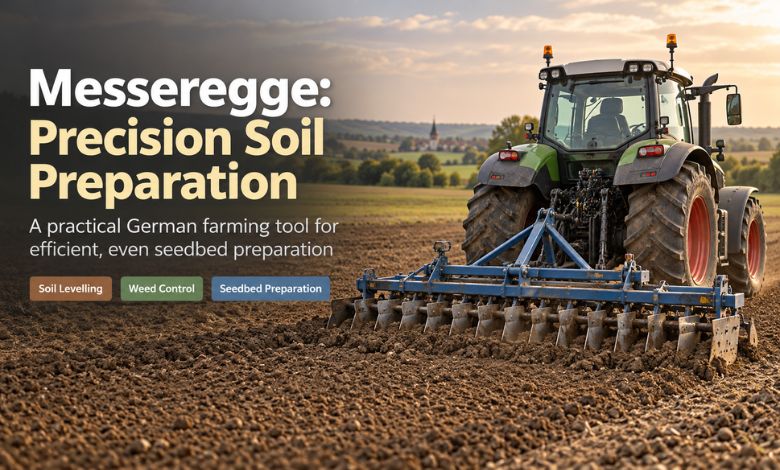
The Messeregge is an agricultural implement connected with shallow soil preparation and seedbed finishing. The German name is formed from Messer, meaning knife or blade, and Egge, meaning harrow. In practical farming terms, it describes a harrow system that uses blade-like working parts to prepare the upper layer of the soil. The term is not widely used in everyday English, which is one reason many people are unfamiliar with it.
For farmers, good soil preparation can make a noticeable difference before sowing begins. The ground needs to be reasonably level, larger clods often need to be reduced, and the seedbed should provide suitable conditions for placing seed at a consistent depth. A Messeregge is designed to help with this finishing work without carrying out the deeper and more aggressive action associated with some other cultivation machines. German agricultural equipment listings still use the term Messeregge, including in connection with front packers, while replacement blades are also sold specifically for Messeregge systems.
What Is a Messeregge?
A Messeregge, commonly explained in English as a knife harrow or blade-style harrow, is used to work the surface of cultivated soil. Instead of relying mainly on large rotating discs, it uses knife-like components that engage with the ground as the machine moves across a field.
Its main purpose is not to completely turn the soil over. It is more focused on preparing the surface after earlier cultivation has already taken place. Depending on the machine, soil type and field conditions, the blades can help reduce clods, loosen a surface crust and improve the overall level of the seedbed.
This makes the implement particularly useful as part of a wider cultivation system. It may be combined with another piece of machinery or fitted with a front-mounted soil preparation unit. Current German machinery listings, for example, describe front packers with Messeregge equipment, showing that the name remains connected with real agricultural machinery rather than being simply an online expression.
Where Does the Name Messeregge Come From?
The meaning becomes easier to understand when the German word is divided into its two parts. Messer means a knife or blade, while Egge refers to a harrow. The combined term therefore describes a harrow that works with knife-like parts.
That distinction is important because some online explanations have confused Messer with the German word Messe, which can mean a trade fair. These are different words. In an agricultural setting, Messeregge is associated with soil-working equipment, not exhibition design or a trade-show system.
There is also physical evidence of the agricultural use of the name. German agricultural parts suppliers sell left and right replacement knives specifically described as blades for a Messeregge, supporting the practical machinery meaning of the term.
How Does a Messeregge Work?
The basic working idea is straightforward. As a tractor moves the implement across prepared land, the blade-shaped components pass through or across the upper soil layer. Their movement affects the surface rather than carrying out deep primary cultivation.
When soil has been ploughed or worked by heavier equipment, it can sometimes be left with larger clods or an uneven finish. A Messeregge can form part of the next stage by helping produce a finer and more even surface.
The exact result depends on factors such as soil moisture, soil texture, travelling speed, machine adjustment and previous field operations. Dry, light ground behaves differently from heavy or wet clay. Farmers therefore need to adjust their machinery according to actual field conditions rather than expecting one setting to work everywhere.
Why Seedbed Preparation Matters
A seedbed is much more than soil that simply looks smooth from above. Seeds need suitable contact with the surrounding soil, access to moisture and enough space for early root development. An extremely rough or badly compacted surface can make even seed placement more difficult.
The Messeregge can help with the finishing stage of this preparation by creating a more consistent upper layer. When larger clods are reduced and rough areas are levelled, drilling or planting equipment can generally work across a more uniform surface.
Good preparation does not mean the soil should be crushed as finely as possible. Overworking ground can also create problems. The goal is normally to achieve a suitable structure for the crop, soil and weather conditions. This is why shallow working tools can have an important place alongside deeper cultivation equipment.
Main Uses of a Messeregge
One of the main uses of a Messeregge is seedbed preparation before sowing. Once the field has received its main cultivation, the implement can help improve the condition of the top layer before seeds are placed.
It can also assist with breaking smaller clods and levelling minor surface irregularities. A more uniform surface may make the following drilling operation easier and help machinery maintain a more consistent working depth.
Another possible role is dealing with light material at the soil surface. Blade action can interact with small amounts of residue while preparing the ground. However, performance will depend heavily on the amount of crop residue present and the design of the particular machine.
Messeregge vs Traditional Harrows
Not every harrow works in the same way. A tine harrow normally uses teeth or tines that move through the ground, while a disc harrow uses rotating discs to cut and mix soil. A Messeregge is distinguished by the use of knife-like or blade-shaped working elements.
The right option depends on the job. Disc equipment may be better where stronger mixing and more intensive cultivation are required. Tine systems can suit many forms of secondary cultivation. The Messeregge is more closely associated with controlled surface preparation and seedbed finishing.
For this reason, farmers should not automatically consider one implement better than another. Each machine is designed for particular soil conditions and cultivation goals. In many farming systems, several different implements may be used during different stages of field preparation.
Benefits of Using a Messeregge
A major advantage is its relatively simple mechanical working principle. Blade-based components can perform useful surface preparation without needing to carry out deep soil movement.
Another benefit is the ability to combine soil finishing with other operations. Machinery advertisements show Messeregge systems fitted with or offered alongside front packers, allowing soil preparation equipment to be organised as part of a combined setup.
Shallow work may also help a farmer avoid disturbing more soil than necessary when deeper cultivation has already been completed. This can make the Messeregge useful as a finishing implement rather than a replacement for all other tillage machinery.
Things Farmers Should Consider Before Using One
A Messeregge will not perform equally well in every field. Soil condition is one of the first things to consider. Ground that is extremely wet may smear or compact rather than break apart cleanly, while very hard and dry ground may require different preparation before a shallow implement can work effectively.
Blade condition is also important. Because the machine depends on its working parts interacting directly with the soil, worn or damaged components can affect performance. Replacement Messeregge knives are available through agricultural parts suppliers, showing that blade inspection and replacement form part of normal equipment maintenance.
Tractor compatibility, working width, mounting system and the intended cultivation sequence should also be considered. Choosing equipment should be based on the farm’s actual soil, crops and machinery rather than the tool’s name alone.
The Role of Messeregge in Modern Farming
Modern agriculture often focuses on completing field work efficiently while creating suitable conditions for crop establishment. This has increased interest in machinery that can perform specific soil preparation tasks without unnecessary passes or excessive disturbance.
The Messeregge fits naturally into this approach because its job is focused. It is not intended to replace a plough, cultivator or every type of harrow. Instead, it can serve as one part of a larger field preparation system.
Its continued appearance in agricultural machinery and spare-parts markets also shows that it remains a practical term within German-speaking farm equipment contexts.
Conclusion
The Messeregge may have an unfamiliar name, but the farming principle behind it is easy to understand. It is a blade-based agricultural harrow used mainly to improve the upper soil layer before planting. By reducing clods, smoothing uneven ground and supporting seedbed preparation, it can play a useful role between primary cultivation and sowing.
Its value comes from doing a specific job without trying to replace every other soil-working machine. For farmers who need controlled surface preparation, a properly selected and adjusted Messeregge can form a practical part of the cultivation process. The term also provides a good example of how traditional agricultural engineering continues to remain relevant as farms look for more efficient and carefully managed field operations.
(FAQs)
What does Messeregge mean?
Messeregge is a German agricultural term formed from Messer, meaning knife or blade, and Egge, meaning harrow. It is generally understood as a knife or blade-style harrow used for soil preparation.
What is a Messeregge used for?
It is mainly used for shallow soil preparation, reducing clods, improving surface level and preparing a more suitable seedbed before sowing.
Is a Messeregge the same as a disc harrow?
No. A disc harrow uses rotating discs, while a Messeregge uses blade or knife-like working parts. The machines can therefore produce different effects on the soil.
Can a Messeregge be used with a tractor?
Yes. Messeregge equipment is used as part of mechanised agricultural systems, and German machinery listings include front packers fitted with Messeregge units.
Does a Messeregge replace other cultivation equipment?
Usually not. It is better understood as a specialised surface-working and seedbed preparation tool. Other machinery may still be required for deeper cultivation, residue management or other field operations.