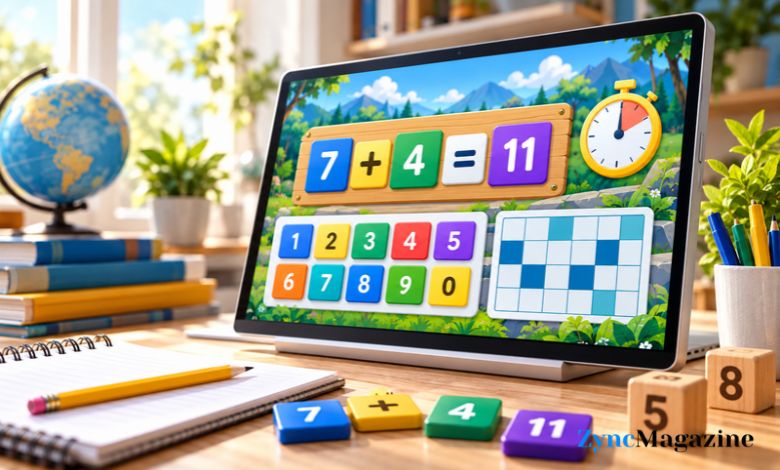
Maths practice is easier to return to when it feels like a challenge you want to finish. Mathplayzone puts number questions inside games that ask players to race a clock, protect a character or solve a puzzle. Instead of facing a page of similar sums, players can choose an activity that gives each answer a purpose.
The site covers addition, subtraction, multiplication and division. It also has games about science, history and geography. That range gives players a chance to change activities when they want a break from arithmetic.
But a game is most useful when you know what you want to practise. Is the goal to remember multiplication facts more quickly? Check subtraction answers more carefully? Work through a number puzzle? This guide explains what Mathplayzone offers and how to turn a few minutes of play into a focused practice session.
What Is Mathplayzone?
Mathplayzone is an online collection of learning games. Its maths section includes separate games for the four basic operations, along with activities that use numbers in puzzles and other challenges. Players can also explore sections for science, history, geography and arcade games.
The activities vary in style. Some present a calculation and ask the player to choose an answer before time runs out. Others ask for a decision, such as whether an equation is true or false. In a puzzle game, the player may need to arrange numbers to clear a path.
This variety is one of the site’s useful features. A player who wants direct arithmetic practice can choose a game for one operation. Someone who enjoys thinking through a puzzle can try a different format while still working with numbers.
Age note: Mathplayzone’s terms state that the website is designed for users aged 13 and older. Parents and teachers should follow that requirement when choosing activities for a learner.
Maths Skills Players Can Practise
The most direct games on Mathplayzone focus on addition, subtraction, multiplication and division. Players work out answers and select them under a time limit. These games offer repeated practice with familiar calculations, which may appeal to learners who already know the method and want to get more comfortable using it.
Addition and subtraction games can help players pay attention to how numbers change. Multiplication and division games give them chances to recall number facts. A player who often pauses at a particular type of question can use that as a clue about what to review.
The timer adds excitement, but it can also make mistakes more likely. If a learner keeps choosing the wrong answer, playing faster probably will not help. It may be better to stop, work through a few examples slowly and then return to the game. Accuracy comes before speed, especially when a skill is still new.
Math Boy: Arithmetic With a Game Goal
Math Boy uses a fantasy setting to turn answers into actions. Players solve arithmetic equations to stop enemies from reaching a sword-wielding character. A correct answer helps defend him, while a wrong answer lets the enemies move closer.
The game offers five modes: addition, subtraction, multiplication, division and a mix of all four. A single-operation mode can help a player focus on one skill. The mixed mode asks them to notice which operation is needed before they calculate.
That difference matters. Solving several multiplication questions in a row is one kind of practice. Switching between multiplication, division and subtraction is another. A learner who feels confident in the separate modes could try the mixed mode to see how well they recognise each question.
Math Push: A Puzzle That Uses Numbers
For players who prefer to think before they act, Math Push offers a different challenge. It asks them to move numbered blocks and create mathematical expressions that match values blocking an exit. Getting through a level involves working out a calculation and deciding how to position the blocks.
This makes the game feel different from choosing an answer on a timer. A player has to consider the numbers available, the value needed and the moves they can make. If the first idea does not work, they can rethink the arrangement.
Math Push may appeal to someone who likes logic puzzles. It gives players a reason to look closely at how numbers fit together, rather than answer one calculation after another.
Read Also: Jipinfeiche: The Meaning Behind Need for Speed’s Chinese Name
Quick Games for Addition and Subtraction
Quiz Math asks players to decide whether an addition or subtraction equation is true or false. They must respond before time runs out. This sounds simple, but it calls for careful reading. An equation that looks familiar may have the wrong answer, so guessing at a glance can end the round.
Two other games work with a running total. In Let’s Reach 1000, players keep adding numbers as they aim for 1000. In Let’s Reach Zero, they subtract numbers to bring a total down to zero. Both games have time limits, which means players must keep track of the total as it changes.
These activities can be a welcome change from isolated questions. Each answer connects to what happened just before it. A player who loses track can pause afterwards and work through the numbers again without the pressure of the clock.
More Than Maths Games
Mathplayzone’s name points to maths, but the site also has other subjects. Its science games include quizzes on topics such as planets and the human body. One game uses examples of solids, liquids and gases, while another introduces science topics through levels.
The history and geography sections use questions to explore facts and places. Players can encounter topics such as historical periods, countries, capitals, landmarks and world flags. These games may suit someone who wants to answer a different kind of question after practising arithmetic.
A quiz can introduce a topic, but it will not explain everything behind an answer. When a player gets a question wrong or finds something surprising, that is a good moment to learn more. Asking “Why is that the answer?” can make the activity more valuable than simply moving on to the next round.
How to Use Mathplayzone for Better Practice
Start with one small goal. A learner might decide to practise division facts, check whether they can spot incorrect addition equations or spend time on a number puzzle. Choosing a goal makes it easier to pick a suitable game and notice what they learned.
Keep the session manageable. After playing, the learner can identify two or three questions that caused trouble and solve them again slowly. If they can explain how they reached the answer, they are doing more than remembering which button they clicked.
Parents and teachers can help by asking simple questions: “Which part was difficult?” “How did you work that out?” or “Would you answer it the same way next time?” The aim is to make room for thinking, without turning every round into a test.
It also helps to choose games that match the learner’s confidence. A timed multiplication game may be enjoyable for someone who knows their tables and wants practice recalling them. Someone who is still learning what multiplication means may need examples and untimed questions first.
What Games Cannot Do on Their Own
Maths games can make practice feel more inviting, but a high score does not tell the whole story. A player might recognise answers in a familiar game yet find it hard to explain the method or use the same skill in a word problem.
That is why it helps to use games alongside other activities. A learner might talk through a question, draw a picture, use objects to show a calculation or write down the steps. Each approach offers a different way to check understanding.
The best result is not always a faster answer. Sometimes it is noticing a mistake, understanding why it happened and getting the next question right. Mathplayzone can provide chances to practise, while explanations and discussion help those answers make sense.
Conclusion
Mathplayzone brings arithmetic into timed games, character challenges and number puzzles. It also offers science, history and geography activities for players who want variety. To get the most from it, choose a game that fits one clear practice goal, revisit difficult questions and make time to talk through the answers.
Games can make maths practice more enjoyable, especially when each session has a purpose. Before using the site, parents and teachers should also note its stated 13-and-older age requirement.
(FAQs)
What is Mathplayzone?
Mathplayzone is a website with online learning games. Its sections include maths, science, history and geography.
Which maths topics are available on Mathplayzone?
Players can find games for addition, subtraction, multiplication and division. Some games focus on one operation, while Math Boy also offers a mixed mode.
Is every Mathplayzone game timed?
No. Several arithmetic games involve a timer, while Math Push focuses on moving numbered blocks and solving a puzzle.
Can children under 13 use Mathplayzone?
Mathplayzone’s terms say the website is designed for users aged 13 and older. Parents and teachers should follow that stated requirement.
Can Mathplayzone replace maths lessons?
It can provide extra practice, but learners may still need explanations, untimed examples and help working through mistakes.