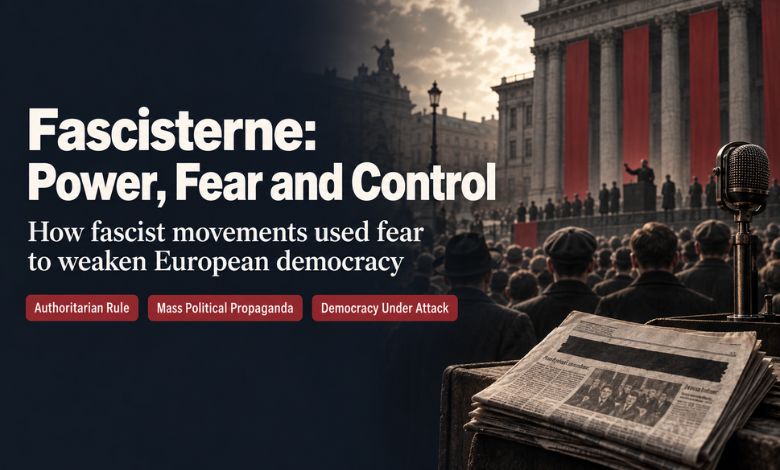
The Danish word fascisterne looks simple enough. Translated into English, it means “the fascists.” Yet anyone who has read about Europe between the two world wars will know that this is not an ordinary political label. It belongs to a period when frustration, fear and promises of national renewal helped dictators gain power.
People did not wake up one morning and willingly choose to lose their freedom. The change happened gradually. Fascist movements first presented themselves as forces of order. They spoke about jobs, national pride, security and strong leadership. Once they had enough power, their language changed, their opponents disappeared, and public disagreement became dangerous.
That history is the reason fascisterne remains a serious word. It describes people who supported a system in which the nation and its leader were placed above individual rights. Understanding the word means looking at the promises fascist movements made, the methods they used and the damage left behind.
A Danish Word With a Clear Meaning
In Danish, one supporter of fascism is called en fascist. The plural form is fascister, meaning fascists. Adding “-ne” creates the definite plural, so fascisterne means the fascists.
It is also worth separating the people from the political idea. Fascisme is the Danish word for fascism, while fascisterne are the people who follow, defend or promote it. The difference may appear small, but it changes the meaning of a sentence.
A history book might use fascisterne for the members of a named political party. A newspaper columnist may use it for a modern extremist group. In everyday arguments, however, people sometimes throw the word at anyone they consider controlling. That casual use does not always match its historical meaning.
What Did Fascisterne Actually Want?
Historical fascisterne did not all agree on every policy. Italian Fascists, German Nazis and smaller European movements developed in different national settings. Still, they shared a recognisable view of political power.
They believed that the state needed a strong leader who could act without the delays of democratic discussion. Political parties, independent newspapers and trade unions were seen as sources of division. Instead of accepting several opinions, fascisterne wanted society to move in one approved direction.
This meant that personal freedom became less important than obedience. Citizens were expected to serve the nation as it was defined by the government. Anyone who questioned that definition risked being treated as disloyal.
Why Ordinary People Listened
It is tempting to imagine every fascist supporter as an openly violent extremist. History was more complicated. Some followers were deeply committed to the ideology, but others were drawn in by promises that sounded practical.
Europe had suffered enormous damage during the First World War. Soldiers returned to uncertain futures, families faced rising costs, and political systems appeared unable to solve growing problems. In several countries, street clashes and economic crises made daily life feel unstable.
Fascist leaders understood this mood. They promised work, discipline and a return to national greatness. Instead of asking the public to consider difficult economic explanations, they gave them a short story: the nation had been betrayed, an enemy was responsible, and only a powerful movement could repair it.
For people who felt forgotten, this message offered a sense of belonging. That did not make the claims true, but it made them politically effective.
Mussolini’s Road to Power
Benito Mussolini became the best-known early leader of a fascist state. His movement grew in Italy after the First World War, presenting itself as a barrier against disorder and left-wing revolution.
Mussolini’s supporters used organised intimidation alongside political campaigning. Opponents were attacked, meetings were disrupted, and fear became part of public life. When Mussolini became prime minister in 1922, some Italians expected him to work within the existing system.
Instead, democratic limits were slowly removed. Opposition parties were weakened, critical newspapers faced control, and Mussolini’s public image became central to the government. Italy still had state institutions, but those institutions could no longer place meaningful limits on the leader.
This gradual change is important. Dictatorship did not arrive with a sign announcing itself. It grew through a series of political decisions that made resistance increasingly difficult.
Hitler’s Germany Took the Idea Further
Adolf Hitler’s Nazi Party shared major features with Italian fascism. It rejected parliamentary democracy, celebrated military strength and demanded loyalty to a single leader. Yet Nazi rule added an especially destructive racial ideology.
Jewish people were blamed for Germany’s problems and excluded from public life. The government also targeted Roma communities, disabled people, political opponents and others it considered undesirable. Racist ideas were turned into laws, and those laws developed into organised persecution and murder.
The result was the Holocaust, during which six million Jewish people were killed. Millions of other people also died because of Nazi policies, occupation and war.
For this reason, Nazism is often discussed as a form of fascism, but the words are not perfect substitutes. Nazi racial beliefs were not a side issue. They stood at the centre of Hitler’s programme.
The Careful Construction of Propaganda
Fascisterne knew that political power depended partly on controlling what people saw and heard. Their leaders were shown in carefully chosen photographs, films and public events. They appeared active, confident and closely connected with the nation.
The same messages were repeated through newspapers, radio broadcasts, posters and school lessons. Government successes were exaggerated. Failures were hidden or blamed on enemies. When an independent newspaper challenged the official story, it could be closed or taken over.
Large rallies also served a purpose. Thousands of people standing beneath the same flags created the feeling that the movement represented everyone. A person watching from outside might begin to wonder whether resistance was already pointless.
Propaganda worked because it mixed emotional language with constant repetition. It did not ask people to investigate. It asked them to feel, follow and obey.
Finding Someone to Blame
Nearly every fascist movement created an enemy. Sometimes it was a religious or ethnic minority. In other cases, the targets were immigrants, socialists, trade unionists or critics of the government.
This tactic made complex problems easier to explain. Unemployment, inflation and social conflict rarely have one cause, but fascist leaders claimed that one group was responsible. The accusation gave angry citizens somewhere to direct their frustration.
Once a community had been described as dangerous, discrimination became easier to defend. Rights could be removed in the name of security. Violence could be presented as protection. The government could then expand its power while claiming that it was only responding to a threat.
Fascisterne and Denmark
Denmark was not untouched by these ideas. The country had its own small fascist and National Socialist groups. The best-known was the National Socialist Workers’ Party of Denmark, generally referred to as DNSAP.
The party borrowed ideas and visual features from the German Nazi movement. It promoted authoritarian nationalism and antisemitism but failed to gain broad support from Danish voters. Even under German occupation, it remained a limited political force.
Germany occupied Denmark on 9 April 1940. The years that followed produced difficult choices. Some Danes resisted the occupation, while others cooperated with German authorities. Many people tried to continue their ordinary lives without becoming directly involved.
Not every collaborator was necessarily a fascist. Some acted for profit, some from fear, and others because they believed cooperation was practical. Committed Danish Nazis, by comparison, had a direct ideological relationship with fascisterne. These distinctions help historians avoid turning a complicated period into an overly simple story.
What Fascist Rule Meant in Daily Life
Political dictatorship was not limited to government offices. It reached into schools, workplaces, newspapers and cultural life. Teachers had to follow approved lessons, while writers and artists learned which subjects could place them in danger.
Independent unions could no longer defend workers freely. Public meetings required permission. Neighbours became careful about discussing politics because they did not know who might report them.
Some citizens adapted because they supported the government. Others remained silent because speaking out could cost them their job, freedom or life. Over time, silence made the government look more popular than it really was.
Why the Word Is Misused Today
Today, the word fascist is often used for an unpleasant boss, a strict rule or a disliked politician. It may express anger, but it does not automatically provide an accurate description.
A movement should not be called fascist simply because it supports national traditions or a strong defence policy. The more serious signs include rejecting fair elections, encouraging violence, attacking independent courts and treating political opponents as enemies of the nation.
The behaviour of the movement matters more than the insult used against it. Does it accept that power can change hands? Does it respect the law when the law limits its leader? Does it allow journalists and citizens to criticise its decisions? The answers provide a stronger basis for judgement.
The Lesson Fascisterne Leaves Behind
The history of fascisterne is not useful because every modern crisis is identical to the 1930s. It is useful because certain political methods remain recognisable.
Fear can still be used to reduce public debate. Minority communities can still be blamed for complicated national problems. Leaders can still claim that courts, journalists and opposition parties are standing in the way of the people.
Democracy is often slow and frustrating, but that is partly because it allows different voices to be heard. Fascism offers speed by removing those voices. The price is paid in lost rights, unchecked power and the disappearance of peaceful political choice.
Conclusion
Fascisterne means “the fascists,” yet the word carries a history that cannot be captured by translation alone. It refers to people who supported political movements based on extreme nationalism, authoritarian leadership and hostility towards democratic opposition.
These movements did not gain attention by advertising repression. They promised stability, work and national recovery. Once they secured power, they controlled information, punished critics and reduced the public’s ability to challenge the government.
Using the term correctly matters. Not every hard policy or nationalist opinion is fascist. The label becomes meaningful when a movement attacks democracy, supports political violence and demands obedience to a leader above the law. That distinction keeps the discussion fair while preserving the warning contained in history.
(FAQs)
What does fascisterne mean?
Fascisterne is a Danish word that means “the fascists.” It is used for a specific group of people who support fascism.
What is the Danish word for fascism?
The Danish word for the political ideology is fascisme. Fascisterne refers to the supporters rather than the ideology.
Did fascisterne become powerful in Denmark?
Danish fascist and Nazi groups existed, but they did not receive wide electoral support. DNSAP remained a relatively small political party.
Were fascism and Nazism exactly the same?
No. They shared authoritarian and nationalist characteristics, but Nazism placed racial ideology and antisemitism at the centre of its programme.
What are the main warning signs of fascist politics?
Common signs include leader worship, extreme nationalism, political violence, attacks on minorities and efforts to weaken elections, courts or independent journalism.