easyJet Flight U2238 Emergency Landing Newcastle: What Happened and Why the Flight Was Diverted

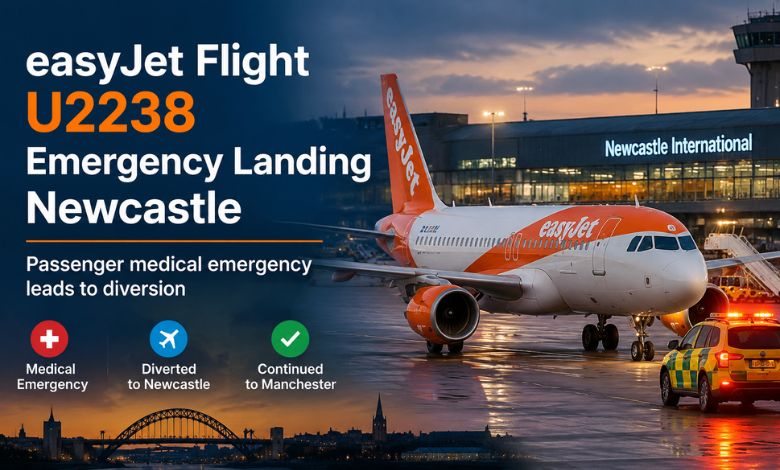
The easyJet flight U2238 emergency landing Newcastle story attracted attention after an easyJet aircraft unexpectedly changed course and landed at Newcastle International Airport instead of continuing towards its planned destination. For passengers and people waiting for relatives, an unscheduled landing can naturally be worrying, especially when early reports provide little detail about the reason for the diversion.
However, there is an important detail to understand before looking at the incident itself. The flight involved in the October 27, 2025 diversion was widely identified as U22238, or EZY2238 in aviation tracking systems. The shorter U2238 refers to a different easyJet service, which has led to considerable confusion online. The Newcastle diversion involved the Copenhagen-to-Manchester service, and available reporting indicates that the emergency was related to a passenger medical problem, rather than a confirmed major aircraft failure.
What Happened During the easyJet Flight?
The aircraft was operating from Copenhagen to Manchester on the evening of October 27, 2025. During the journey, a passenger became unwell and required urgent medical attention. The situation was serious enough for the flight crew to declare an emergency and begin considering the safest airport for a diversion.
Rather than continuing towards Manchester, the crew diverted the aircraft to Newcastle International Airport. This decision is a normal part of aviation emergency management because pilots must consider factors such as the condition of the passenger, distance to suitable airports, weather, runway availability and the ability of medical teams to respond quickly. The diversion allowed the aircraft to reach an airport where assistance could be arranged before continuing the journey.
The phrase emergency landing can sound more dramatic than the actual situation. In commercial aviation, an emergency declaration does not automatically mean the aircraft is suffering a catastrophic technical problem. An urgent medical incident involving a passenger can also lead the crew to request priority handling and divert to another airport.
Why Was Newcastle Chosen?
Newcastle International Airport was used as the diversion point because it offered a suitable location for the aircraft to land while the passenger received urgent medical assistance. Once an emergency has been declared, air traffic controllers work with the flight crew to make the arrival as efficient and safe as possible.
The aircraft can receive priority treatment, while other flights may be delayed, rerouted or placed into holding patterns to create space for the emergency aircraft. This is part of the wider safety system used at busy airports when an aircraft requires immediate assistance. Reports surrounding this incident indicate that the easyJet aircraft reached Newcastle safely and that medical support was available after landing.
For passengers onboard, a diversion can still be unsettling because it changes the expected journey without much warning. Yet from an operational point of view, changing the route is often the safest option when a passenger needs urgent care. Pilots are trained to make these decisions conservatively, with safety taking priority over keeping to the original schedule.
Was There a Mechanical Problem With the Aircraft?
There has been speculation online about whether the easyJet aircraft experienced a serious technical failure. The available reports, however, connect the diversion primarily with a passenger medical emergency or passenger welfare concern.
That distinction matters. When an aircraft declares an emergency, people watching flight-tracking websites may see emergency indicators and assume the plane itself is in danger. But an emergency declaration is a broad signal. It tells air traffic control that the aircraft needs urgent assistance, without explaining the precise nature of the problem.
The reported use of Squawk 7700 is consistent with a general emergency declaration. The code is used in aviation to alert air traffic control that an aircraft is experiencing an emergency, but it does not by itself identify whether the situation involves a medical event, technical issue, weather problem or another concern.
In this case, the strongest available information points towards a medical reason for the diversion rather than a confirmed major aircraft malfunction.
The Important U2238 and U22238 Confusion
One of the biggest issues surrounding this incident is the flight number. Many online searches use the phrase “easyJet flight U2238 emergency landing Newcastle”, but that wording can be misleading.
The flight associated with the October 27, 2025 diversion was identified as U22238 and also as EZY2238. easyJet uses the airline code U2, while aviation tracking systems commonly use the three-letter identifier EZY. As a result, the same service can appear in different formats depending on the system being used.
The separate U2238 identification is associated with an easyJet service between Newcastle and Bristol. This means that removing one of the repeated digits can change the identity of the flight completely. That is why the route and date are useful when checking reports about the incident.
For readers searching for the easyjet flight u2238 emergency landing newcastle, the clearest description is that the widely discussed diversion involved easyJet U22238/EZY2238, the Copenhagen-to-Manchester service that diverted to Newcastle after a passenger required urgent medical attention.
What Happened After the Aircraft Landed?
After reaching Newcastle, the immediate priority was the passenger who had become unwell during the flight. Medical personnel were able to respond once the aircraft was safely on the ground. Public reports confirm that the passenger received medical attention, although detailed personal medical information was not publicly disclosed.
Keeping a passenger’s medical details private is important. It is understandable that people may want to know exactly what happened, but unless an airline, medical authority or another reliable source confirms those details, it would be inappropriate to speculate about a diagnosis or the person’s later condition.
The situation did not end with the aircraft remaining in Newcastle for the rest of the journey. Following the diversion and necessary checks, the aircraft later continued towards Manchester. This is another important part of the story because it shows that the diversion itself did not mean the aircraft had suffered damage or had to be taken out of service permanently.
Why Emergency Landings Are Taken Seriously
An emergency landing is always treated seriously, even when the aircraft ultimately lands safely. Airlines and airports are designed around the principle that it is better to respond early than to wait until a situation becomes more difficult.
A medical emergency is a good example. If a passenger’s condition appears to be worsening and a suitable airport is available nearby, continuing a long journey may create unnecessary risk. Diverting gives emergency teams a chance to meet the aircraft sooner and gives the crew access to airport facilities that may not be available in the air.
This approach also explains why passengers might see emergency vehicles near an aircraft after landing. Their presence does not necessarily mean there has been an aircraft accident. Often, emergency teams are simply positioned and ready because the flight was declared an emergency before arrival.
What Can Passengers Learn From the Newcastle Diversion?
The incident offers a useful reminder that flight diversions are part of normal aviation safety procedures. Passengers generally expect a journey to follow the published route, but pilots must be prepared to change plans when circumstances require it.
A diversion can happen because of a medical issue, severe weather, airport problems, technical concerns or another operational reason. The decision is based on the circumstances at that moment and the safest available options.
The easyJet incident also demonstrates why online flight information needs to be checked carefully. A dramatic headline may use the phrase “emergency landing”, while the actual circumstances may be very different from what readers initially imagine.
In this case, the most useful information is that the aircraft diverted safely to Newcastle, the reported emergency involved a passenger needing urgent medical help, and the aircraft later continued to Manchester.
Does the Incident Mean easyJet Passengers Were in Danger?
There is no evidence from the available reporting that the flight ended in a crash or that the aircraft suffered a catastrophic event. It is important not to confuse an emergency declaration with an aircraft being on the verge of destruction.
The crew’s decision to divert demonstrated that the situation was being actively managed. Air traffic control supported the diversion, Newcastle was prepared for the arrival and medical assistance was available once the aircraft landed.
For passengers, the experience may still have been stressful, but an unscheduled landing can be the result of a careful safety decision rather than a sign that something has gone badly wrong with the aircraft itself.
Why Accurate Reporting Matters
Incidents involving passenger aircraft quickly attract attention because people naturally want answers. But aviation stories are particularly vulnerable to misunderstandings because flight numbers, tracking codes and emergency terminology can look confusing to people who do not regularly follow the industry.
The U2238 and U22238 mix-up is a good example. One missing digit can lead readers to the wrong route and even the wrong flight. Using the correct identifier, while also acknowledging the search term people are using, provides a much clearer account of what actually happened.
The available evidence supports a straightforward explanation: the Copenhagen-to-Manchester easyJet service diverted to Newcastle after a passenger required urgent medical attention, landed safely, received medical support on the ground and later continued its journey to Manchester.
Conclusion
The easyjet flight u2238 emergency landing newcastle incident was an unexpected diversion that ended with the aircraft landing safely at Newcastle International Airport. The available information indicates that the main concern was a passenger medical emergency, not a confirmed catastrophic aircraft fault, and medical assistance was arranged after the aircraft arrived.
The story also highlights how easily flight numbers can be misunderstood online. Although many searches use U2238, the flight connected with the October 27, 2025 incident was more accurately identified as U22238 or EZY2238. After the situation was handled at Newcastle, the aircraft continued to Manchester, bringing the disrupted journey to a safe conclusion.
(FAQs)
What happened to easyJet flight U2238 in Newcastle?
The incident commonly described online as the easyJet flight U2238 emergency landing Newcastle involved the Copenhagen-to-Manchester service identified as U22238 or EZY2238. The aircraft diverted to Newcastle after a passenger required urgent medical attention and later continued to Manchester.
Why did the easyJet flight divert to Newcastle?
The available reports indicate that the diversion was caused by a passenger medical emergency. The crew declared an emergency so the aircraft could land at a suitable airport where medical assistance could be provided quickly.
Was there a serious mechanical failure?
There is no confirmed public evidence in the available reporting of a major aircraft failure being the cause of the diversion. The reported reason was a passenger welfare or medical issue. The emergency transponder code alone cannot be used to determine the cause.
Did the plane reach Manchester after landing in Newcastle?
Yes. After the emergency response and necessary ground procedures, the aircraft later continued to Manchester. The diversion therefore changed the route temporarily rather than ending the flight completely.
Is U2238 the correct flight number?
Not for the Newcastle diversion discussed here. The flight involved was reported as U22238/EZY2238, while U2238 refers to a separate easyJet service. The similarity between the numbers is the main reason for the confusion surrounding online searches about this incident.