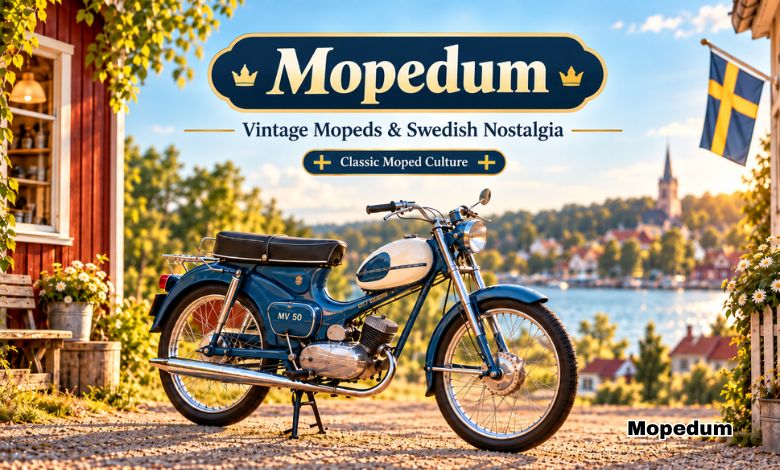
Mopedum is a name associated with veteran mopeds, classic scooters, Swedish nostalgia, and the history of small two-wheel vehicles. Today, the Mopedum website describes its focus as vintage mopeds and nostalgia, with content covering unusual mopeds, scooters, collections, maintenance, buying older machines, and what it calls the golden age of moped culture.
The name also has an important connection with a former museum in Nynäshamn, Sweden. That museum was designed as a nostalgic journey through earlier decades, using old mopeds alongside objects from everyday life. It was not simply a room filled with machines. The wider idea was to recreate memories of the 1950s, 1960s, and 1970s and show how mopeds belonged to the social life of those years.
This combination of machinery and memory explains why Mopedum still attracts interest. Some people arrive because they love old engines and mechanical design. Others are interested in the clothes, products, habits, and atmosphere of previous generations. For many enthusiasts, however, the real attraction lies somewhere between the two.
The Former Mopedum Museum in Nynäshamn
The original physical Mopedum attraction was located at Vikingavägen 39 in Nynäshamn. Tourism information for the museum described it as a place for visitors interested in veteran mopeds and nostalgic objects from the past. Its exhibits were intended to take people back to the 1950s, 1960s, and 1970s.
That approach gave Mopedum a character of its own. A classic moped can be interesting when viewed on its own, but it becomes more meaningful when placed within the period in which people actually used it. Household objects, leisure items and other familiar details helped create that setting.
For someone who lived through those decades, a visit could bring back personal memories. Younger visitors could experience a small part of a world they knew only through parents, grandparents, photographs or old films. This made the museum relevant to a wider audience than dedicated moped collectors alone.
When Did the Mopedum Museum Close?
The physical museum is no longer open. A tourism listing for Mopedum clearly stated that the museum would close for good in December 2022. A Swedish motorcycle forum also discussed the planned permanent closure at the end of that year.
It is therefore important not to describe Mopedum as a currently operating museum. The physical attraction belongs to the past.
The Mopedum name, however, is still active on the web. The current mopedum.se website publishes material about veteran mopeds and nostalgia. Recent posts on the site include content from 2024, 2025 and January 2026, showing that the website itself remains active.
Why 1952 Matters in Swedish Moped History
To understand Mopedum properly, it helps to understand why mopeds became so important in Sweden.
A major date is 1 July 1952. Research published through KTH Royal Institute of Technology explains that new Swedish rules took effect on that date, separating the “bicycle with auxiliary engine” from restrictions applying to heavier motorised two-wheelers. Under the rules of the time, owners did not need vehicle registration, a driving licence or vehicle tax for this new class of machine.
The early vehicle was still expected to resemble a bicycle and have pedals. The idea was practical: it was meant to provide useful transport rather than simply become a smaller motorcycle.
That did not remain the full story for long. Users and manufacturers helped push the moped in a different direction. It gradually became associated not only with practical travel but also with leisure and personal freedom. In 1961, Swedish regulations changed again, and the requirement that the moped resemble a bicycle and use pedals was removed.
This changing identity from practical machine to symbol of mobility and freedom is an important part of the culture celebrated around veteran mopeds.
How Mopeds Became Everyday Machines
The appeal of the classic moped was easy to understand. It offered powered transport in a small package and required less space than a car or full-sized motorcycle.
For workers, a moped could make a local commute easier. For young riders, it could open up a much larger world. Visiting friends, getting to work or simply travelling beyond the immediate neighbourhood became easier when a person had access to a motorised two-wheeler.
That sense of independence became part of the moped’s identity. Academic research into Swedish moped history describes the change from an intended utility vehicle towards a machine increasingly connected with leisure and freedom.
This is also why old mopeds can carry such strong emotional value today. Their importance is not always measured by speed, engine power or financial value. A particular machine can remind its owner of a particular year, journey or stage of life.
Mopedum and the Love of Veteran Mopeds
The present Mopedum website places veteran mopeds at the centre of its content. It highlights classic machines, scooters and collections, while also publishing material about ownership and care.
That focus reflects a hobby built around more than buying an old vehicle and storing it in a garage. Many enthusiasts want to understand how a machine was made, how it should run and which details belong to its original design.
Small details often matter. A fuel tank, lamp, seat, engine component or badge may help identify a particular period or version. Some owners want a clean restoration, while others prefer to keep as much original material as possible.
There is no single reason people become interested in classic mopeds. For one owner, it may be mechanical curiosity. For another, it may be childhood nostalgia. Someone else may simply enjoy the design of machines built several decades ago.
Restoration Is Part of the Experience
Owning an old moped often means accepting that it may need work. Machines that have spent years unused can develop fuel-system problems, corrosion, worn cables, electrical faults and damaged rubber parts.
Restoration therefore requires patience. The job is not simply to make a vehicle look attractive. Brakes, tyres, steering, fuel delivery and other mechanical parts also need careful attention if the machine is expected to be used again.
Finding suitable parts can become part of the hobby. Popular models may have a healthy supply of replacement items, while unusual machines can be more difficult. In those cases, old manuals, specialist knowledge and other enthusiasts become particularly valuable.
The current Mopedum site reflects this practical side of the hobby as well. Its recent material includes guidance for people considering the purchase of a veteran moped and discussions of caring for vintage machines.
Famous Types of Mopeds Remembered by Enthusiasts
Mopedum’s own material discusses several machines that have remained familiar in Swedish veteran-moped circles. These include names such as Puch Dakota, Crescent Compact, Monark Monarped, Sachs Saxonette and Zündapp KS50.
The differences between these machines are part of what makes collecting interesting. Some have a straightforward everyday look, while others have a more sporting appearance. Frames, fuel tanks, engines and styling also changed as manufacturers responded to changing tastes.
It would be misleading to suggest that every old moped is rare or financially valuable. Historical interest and market value are not the same thing. A common machine can still matter greatly to its owner because of its condition, family history or connection with a particular period.
That personal side of collecting fits naturally with the idea behind Mopedum.
More Than an Engine and Two Wheels
One reason the former Mopedum museum stood out was its decision to place mopeds within a broader nostalgic environment.
This matters because a vehicle never exists alone. It belongs to the streets, homes, music, fashion and habits of its period. Looking at the objects surrounding a moped can therefore reveal almost as much as studying the machine itself.
The tourism description of Mopedum specifically presented the attraction as a journey back through the 1950s, 1960s and 1970s, combining veteran mopeds with recognisable objects from those decades.
That made Mopedum a form of social history as much as a transport display. It showed how an ordinary object can become a valuable reminder of daily life once enough time has passed.
Why Mopedum Still Has an Audience
There is something appealing about a machine whose working parts can still be understood without a computer screen. Vintage mopeds come from a period of relatively direct mechanical engineering, and this can make them enjoyable projects for people who like to repair and maintain things themselves.
Nostalgia adds another layer. A veteran moped may remind someone of being young, learning basic mechanics or gaining more freedom to travel.
At the same time, a new generation can enjoy the machines without having lived through their original era. Classic design, unusual engineering and the satisfaction of restoring something old can be enough to create an interest.
The current Mopedum website continues to build around these themes, presenting old mopeds as objects of nostalgia, collecting and mechanical interest rather than simply obsolete transport.
Preserving a Small Part of Transport History
Classic cars and motorcycles often receive considerable attention, but mopeds also deserve a place in transport history. They were affordable everyday machines and formed part of ordinary people’s lives.
Preservation can take several forms. Keeping a complete moped is one. Saving photographs, brochures, workshop manuals and original parts is another. Personal memories are valuable too, because technical specifications cannot explain how a vehicle felt to the people who actually used it.
This is where a subject such as Mopedum becomes particularly interesting. It connects the physical machine with the experiences surrounding it.
The old museum may have closed, but the larger story of Swedish moped culture is still being recorded, restored and discussed.
Conclusion
Mopedum tells two closely related stories. One is the story of a former nostalgia museum in Nynäshamn that brought old mopeds together with memories of Swedish life in the 1950s, 1960s and 1970s. That physical museum closed permanently in December 2022.
The other story is still visible online. The Mopedum website continues to focus on veteran mopeds, scooters, collections and the culture surrounding these machines.
Behind both is a much longer piece of Swedish transport history. The moped gained its distinctive legal position in Sweden on 1 July 1952 and later developed from a practical form of transport into something strongly associated with mobility, youth and freedom.
That history explains why Mopedum remains interesting. Old mopeds are modest machines, but they hold memories of design, everyday travel and changing lifestyles. For collectors, restorers and anyone curious about Swedish nostalgia, they offer a genuine connection with the past.
(FAQs)
What is Mopedum?
Mopedum is a name associated with veteran mopeds, classic scooters and Swedish nostalgia. It was also the name of a physical nostalgia museum in Nynäshamn, while the current Mopedum website focuses on vintage mopeds and related subjects.
Where was the Mopedum museum?
The former museum was at Vikingavägen 39, Nynäshamn, Sweden.
When did Mopedum close?
The physical Mopedum museum closed for good in December 2022.
Is the Mopedum website still active?
Yes. mopedum.se currently carries material about veteran mopeds and nostalgia, including posts published in 2025 and 2026.
When did the moped become legally established in Sweden?
An important Swedish legal change took effect on 1 July 1952, when bicycles with auxiliary engines were exempted from several rules that applied to heavier motorised two-wheelers.