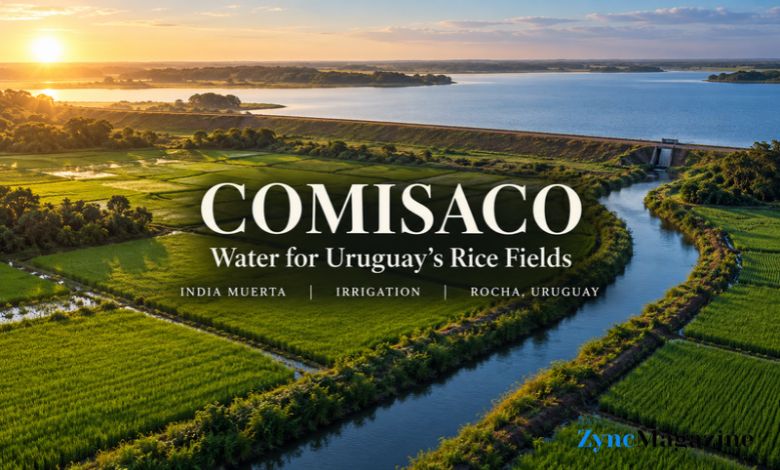
A rice harvest begins long before the grain reaches a processing plant. It starts with prepared land, careful planning and access to enough water during the growing season. In the department of Rocha, eastern Uruguay, the India Muerta dam forms an important part of that process. Comisaco S.A. manages the concession for this irrigation resource.
The company’s role connects a large reservoir with the practical needs of nearby rice growers. Through an extensive canal network, water from India Muerta reaches agricultural land across the surrounding area. Understanding Comisaco means understanding how this connection between stored water and working farms helps support one of the region’s established agricultural activities.
What Is Comisaco?
Comisaco is a Uruguayan company associated with the administration of the India Muerta dam concession. Its main relevance lies in the irrigation system serving rice cultivation in eastern Uruguay.
To understand its position, it helps to follow the crop backwards from the finished product. Before rice can be processed, transported or sold, it must be grown successfully. That requires suitable conditions in the field, including a planned water supply.
Comisaco operates within this essential stage of the agricultural chain. Its connection to irrigation places it close to the everyday concerns of growers, whose planting decisions depend partly on the resources available to support their crops.
The India Muerta Dam and Its Location
The India Muerta dam is located between Velázquez and Lascano, in Uruguay’s Rocha department. This places it within a landscape where rice cultivation has a strong local presence.
A reservoir allows water to be stored for later use. However, storing water is only one part of an irrigation service. There must also be a way to move it from the reservoir towards the land where it is needed.
At India Muerta, the canal network provides that connection. The dam and its associated channels therefore need to be understood together. One holds the resource, while the other helps make that resource useful across the farming area.
A Canal Network Serving Thousands of Hectares
SAMAN describes the India Muerta irrigation network as having more than 200 kilometres of canals and supplying approximately 10,000 hectares of rice fields annually. These figures give a sense of the scale of the system connected to Comisaco.
A network of this size serves an agricultural area with many separate fields and different water needs. Its value comes from connecting the reservoir with those growing areas through an organised distribution system.
The annual hectare figure is approximate. It should not be read as a guarantee that precisely the same amount of land will be irrigated every year. Published capacity and actual seasonal use describe different things, even when both help explain the importance of the infrastructure.
Comisaco’s Connection With SAMAN and COOPAR
SAMAN owns a 50% share in Comisaco, while COOPAR is also a shareholder. These links place the company within Uruguay’s wider rice industry.
The relationship is understandable when the needs of the crop are considered. Rice processors depend on harvested grain, while growers depend on the conditions needed to produce it. Irrigation sits near the beginning of that chain.
The shareholder connection also helps explain why Comisaco appears in information about related rice businesses. Its work addresses a shared agricultural need: managing infrastructure that supports water access for cultivation. That gives the company a specific place within an industry involving both farming and processing.
An Irrigation Service Operating Since 1982
The India Muerta irrigation service began operating in 1982. This long history shows that the system has been part of the region’s agricultural activity for more than four decades.
The date relates to the beginning of irrigation service. It should be kept separate from questions about when the company was incorporated or when every construction stage was completed.
Long-serving infrastructure has a different rhythm from a single farming season. Crops are planted and harvested within a limited period, but reservoirs and canals are intended to serve repeated cycles of cultivation. Their importance builds through continued use, making them part of the working landscape rather than a temporary agricultural investment.
Why Irrigation Matters to Rice Growers
For rice farmers, water is part of planning from the start. Before planting, growers must consider whether available supplies can support the crop alongside the land, equipment and labour they intend to use.
Access to irrigation can help farmers organise those decisions. Yet water availability alone does not determine the result of a harvest. Soil conditions, crop management, weather and other factors also influence production.
The timing and use of irrigation matter as well. Effective water management involves meeting the crop’s needs while avoiding unnecessary use. This is why irrigation infrastructure has a practical role throughout the growing process, rather than being relevant only when rainfall is limited.
The Reservoir’s Storage Capacity
COOPAR describes India Muerta as having approximately 127.5 million cubic metres of usable stored water. It also gives the dam’s embankment length as about 3,200 metres.
These measurements describe different features of the infrastructure. Water volume helps explain storage capacity, while embankment length describes the physical scale of the dam. Neither figure alone shows how much water will be available to every field during a particular season.
A useful way to understand the system is to consider storage, distribution and field use together. Water must first be available, then move through the network, and finally be managed according to farming needs. Each stage contributes to the usefulness of the overall service.
Rice Farming and the Identity of Lascano
Nearby Lascano is widely associated with rice production and is described by Rocha’s official tourism information as the “capital of rice.” The town serves a surrounding area where agriculture and related businesses play an important role.
This local connection gives Comisaco’s work a broader setting. Irrigation infrastructure supports cultivation, while cultivation helps sustain activity around machinery, transport, processing and other agricultural services.
Rice is also part of how the area presents itself to visitors. Opportunities to learn about sowing, irrigation and harvesting reflect the crop’s place in local life. The fields are both places of production and a visible part of the region’s identity.
Using Water Carefully Over the Long Term
Agricultural water management requires attention to both present needs and future use. A reservoir may be large, but its supply remains a resource that needs careful planning.
For irrigation systems generally, clear information about water availability, sound infrastructure and communication with users can help support better decisions. Improvements in measurement and farming practices can also contribute to more efficient use.
These are useful principles for understanding the responsibilities surrounding a system such as India Muerta. They should be distinguished from claims about particular projects or technologies used by Comisaco, which require specific evidence. The company’s documented role is enough to show why water management matters to its place in the rice industry.
Conclusion
Comisaco is closely connected to the relationship between the India Muerta reservoir and rice farming in eastern Uruguay. Its administration of the dam concession places it within an irrigation system that serves a substantial agricultural area.
The company’s importance becomes clear when water is viewed from the grower’s perspective. Stored water must be connected to fields through useful infrastructure and organised management. That practical link explains Comisaco’s role in the farming landscape around Velázquez and Lascano.
(FAQs)
What is Comisaco?
Comisaco S.A. is a Uruguayan company that administers the concession for the India Muerta dam, which supplies an irrigation system associated with rice farming.
Where is the India Muerta dam located?
The dam is in Rocha department, eastern Uruguay, between the towns of Velázquez and Lascano.
Who owns shares in Comisaco?
SAMAN holds a 50% share in Comisaco. COOPAR also confirms that it is a shareholder.
How much farmland does the irrigation system serve?
The network is described as irrigating approximately 10,000 hectares of rice fields annually, with more than 200 kilometres of canals.
When did the irrigation service begin?
The India Muerta irrigation service started in 1982, establishing a long connection between the reservoir and rice production in the surrounding region.