Artificial intelligence used to feel like something that belonged mainly to chatbots and experiments. Ask a question, get an answer, write a paragraph, create an image and move on. That is still useful, but the way businesses are looking at AI is changing.
Companies do not just want another tool sitting in a browser tab. They want something that can fit into the work they are already doing.
This is where FancyAI Skills become interesting.
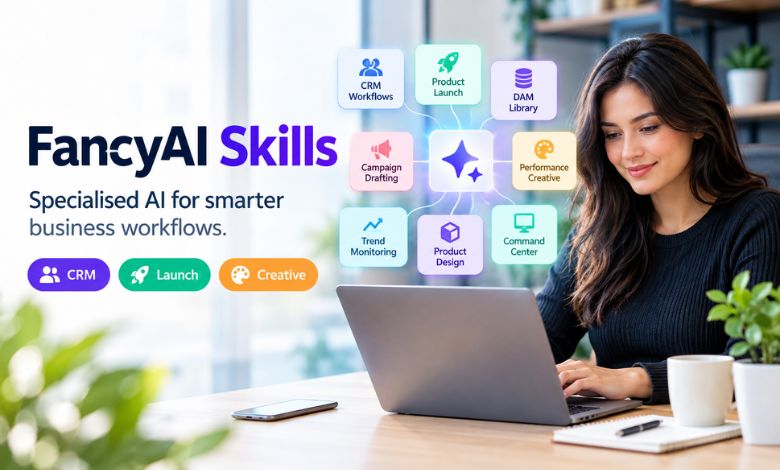
FancyAI is built around specialised AI capabilities that focus on particular areas of business and creative work. Its current platform lists skills covering CRM workflows, product launches, digital asset management, campaign drafting, performance creative, trend monitoring, product design and a desktop command centre.
The idea sounds simple, but it solves a real problem. Businesses already have customer records, product data, images, advertising accounts and other digital resources. The difficult part is often making all of that information work together.
FancyAI is trying to bring those pieces closer through specialised AI.
What Exactly Are FancyAI Skills?
The easiest way to understand FancyAI Skills is to think of them as AI capabilities built for specific jobs.
A general AI assistant may be able to help with almost anything. That flexibility is useful, but business work is usually more focused. A marketing team might need help with campaign ideas, while a sales team needs help understanding customer behaviour. A creative team may spend hours searching for the right brand image.
Those are very different tasks.
FancyAI separates these needs into specialised skills. Its official desktop page currently includes CRM Workflows, ERP Launch, DAM Library, Campaign Drafting, Performance Creative, Trend Monitoring, Product Design and Desktop Command Center.
That structure makes the platform easier to picture. Instead of asking one AI to be a marketer, designer, analyst and operations assistant at the same time, different capabilities can be used for different parts of the job.
Why Does Specialisation Matter?
There is a big difference between generating content and understanding the environment in which that content will be used.
Imagine a company preparing to launch a new product. The basic product information may already exist in its internal system. Photos may be stored somewhere else. Customer information could be in a CRM, while the advertising account is on another platform.
A normal chatbot does not automatically know all of that.
FancyAI’s approach is built around connecting AI with CRM, ERP, DAM, social channels and advertising platforms. Its product offering also describes specialised AI Experts that can be plugged into existing workflows through dedicated API endpoints.
That is important because useful business AI often depends on context.
The more relevant information an AI has access to, the more closely its work can match the actual needs of a business.
CRM Workflows and Customer Engagement
Customer data can tell a business a lot, but looking through that information manually can take time.
FancyAI includes a CRM Workflows skill designed around customer behaviour and engagement. The company says this capability can identify churn signals and help create personalised re-engagement campaigns from CRM data.
Think about a company with thousands of customers. Some may be highly active, some may have stopped buying, while others may have shown interest without completing a purchase.
A specialised AI workflow can help make sense of these patterns and turn them into possible marketing actions.
That does not mean the AI should decide everything on its own. Marketing still needs people who understand the audience and the brand. But having AI handle some of the research and preparation can make the process less repetitive.
This is one of the reasons FancyAI Skills are different from a simple writing assistant. The goal is to work with business information, not just produce words.
ERP Launch Can Connect Products With Marketing
Product launches involve more work than most people realise.
A new product may require a description, technical information, promotional images, a campaign and several other assets before customers even see it.
FancyAI lists an ERP Launch skill that connects product information from an ERP system with launch-related asset creation. According to the platform, new product entries can be used to trigger marketing assets, specification sheets and visuals.
That could be particularly useful for companies that launch products frequently.
Instead of copying product information between different systems and starting creative work from scratch, a connected workflow can use existing data as its starting point.
It is a small change in how work is organised, but small changes can matter when the same process is repeated dozens or hundreds of times.
DAM Library Makes Creative Assets Easier to Find
Creative teams know how quickly digital files can pile up.
A company might have product photography, old campaign images, logos, videos and design files spread across a large library. Finding one approved image can sometimes become a surprisingly time-consuming task.
The DAM Library skill is aimed at this problem.
FancyAI says it can help search, organise and reuse approved brand assets while keeping output aligned with creative standards.
That has a practical benefit. Teams spend less time hunting through folders and more time actually working with the assets.
It can also reduce the risk of someone accidentally using an outdated version of a logo, product image or campaign graphic.
For larger brands, where consistency matters across many channels, organised access to approved creative material can make everyday work much smoother.
Campaign Drafting Gives Marketers a Starting Point
There is a particular moment in marketing that everyone knows.
The project has started, the deadline is getting closer, and someone says, “We need some ideas.”
That is where Campaign Drafting can help.
FancyAI says this skill can create campaign briefs, copy angles, landing-page sections and ad variations using a prompt connected to business data.
The useful part is not that AI can magically create a perfect campaign. It usually cannot.
The useful part is speed.
Instead of spending a long time staring at a blank document, a marketer can get several directions to work from. The person can then rewrite, combine or reject those ideas.
In real-world creative work, having a rough starting point is often much easier than having no starting point at all.
Performance Creative Looks at What Already Works
Advertising teams are constantly testing.
One image performs better than another. One headline gets more clicks. A certain hook attracts more attention. Then the team needs to figure out what to do next.
FancyAI’s Performance Creative skill is designed around this type of process. The platform says it can turn successful hooks and advertising results into fresh creative variations for paid social channels such as Meta and TikTok.
This creates a useful connection between performance data and creative production.
Instead of treating every new advertisement as a completely new experiment, teams can use previous results as part of the next round of development.
There is still a human element here. Performance numbers can point to patterns, but they do not always explain the full story. Someone still needs to understand the market and decide which direction makes sense.
Trend Monitoring for Fast-Moving Social Content
Trends are difficult because they rarely wait for a convenient time.
A topic can become popular quickly, and brands that take too long to respond may miss the conversation altogether.
FancyAI lists Trend Monitoring as a skill that can track social signals and turn emerging topics into captions, visuals and content plans that fit a brand’s style.
For content teams, that could mean less time spent manually scanning for ideas.
But there is an important difference between finding a trend and understanding it.
A trend might be popular but completely wrong for a particular audience. It may also be sensitive or easy to misunderstand.
That is why AI can be useful for discovery while people remain responsible for deciding what is actually worth publishing.
Product Design Is Part of the Picture Too
It would be easy to assume that FancyAI Skills are mainly about marketing. They are not.
The platform also lists Product Design as one of its skills. FancyAI describes this capability around studying successful aesthetics, exploring silhouettes and developing pattern directions.
This is interesting because design is usually associated with hands-on creative thinking.
AI does not have to replace that creative process. It can simply give designers more options to explore.
A designer may start with a basic direction and use AI to experiment with variations. Some ideas will be useful. Others will go nowhere.
That is normal in creative work.
The real value is having the ability to explore more possibilities without spending the same amount of time on every early concept.
The Desktop Command Center
Perhaps the clearest sign of FancyAI’s overall direction is its Desktop Command Center.
FancyAI says the desktop environment is designed to connect tools, files, systems and agents in one workspace. The company currently lists integrations involving services and platforms such as Salesforce, HubSpot, Meta Ads, TikTok Ads, Instagram, Slack, Gmail, Google Drive, Notion and Canva.
This is where the platform starts to look less like a traditional chatbot.
The idea is to bring AI closer to the software businesses already use.
Instead of constantly switching between systems, a team can have AI working within a connected environment where information and assets are already available.
FancyAI’s product page also describes API-based AI Experts, allowing businesses to select specialised experts and integrate the capabilities they need into their existing workflows.
FancyAI Skills and the Human Role
There is a common assumption that when AI becomes more capable, people will simply disappear from the process.
Real business work is rarely that simple.
A company still needs people to decide what matters, what should be changed and what should never be published. AI can produce ideas and handle repetitive tasks, but it does not remove the need for judgement.
That is especially true in areas such as customer communication, advertising and design.
FancyAI Skills are best understood as support for business workflows, not as a reason to stop thinking.
The platform itself talks about AI employees and autonomous execution, but the practical value for a company will depend on how well the tools fit its systems, data and processes.
Why Businesses Are Paying Attention to This Model
The interesting thing about FancyAI is not simply that it uses AI.
There are already countless AI products.
What makes this approach different is the emphasis on specialised roles and connected workflows.
A business has information in many places. If AI can work with those systems, it can potentially become part of the actual process rather than remaining a separate tool people use occasionally.
That shift matters.
The future of business AI may not be about having the most impressive chatbot. It may be about having AI that can quietly handle useful parts of everyday work.
Final Thoughts
FancyAI Skills offer a more specialised way of thinking about artificial intelligence.
Instead of using one general system for everything, the platform brings together capabilities designed for customer engagement, product launches, digital assets, campaign creation, advertising, trend monitoring and product design.
Its focus on connecting AI with existing business systems is equally important. CRM data, ERP information, creative files and advertising platforms can all become part of a broader workflow rather than remaining isolated pieces of information.
That does not mean AI will suddenly solve every business problem.
It does, however, show where workplace AI appears to be heading: away from simple prompts and towards specialised digital workers that can take part in real processes.
For businesses exploring this next stage of AI, FancyAI is an example of how that shift is beginning to take shape.
(FAQs)
What are FancyAI Skills?
FancyAI Skills are specialised AI capabilities designed for specific business and creative tasks. FancyAI currently lists skills for CRM workflows, ERP launches, digital asset management, campaign drafting, performance creative, trend monitoring, product design and desktop workflow management.
What is FancyAI mainly used for?
FancyAI is designed to support business and creative workflows, including customer engagement, product launches, advertising, marketing campaigns, asset management, trend response and design.
Can FancyAI work with existing business systems?
Yes. FancyAI says its desktop platform can connect with systems such as CRM, ERP and DAM platforms, along with social and advertising services. Its product offering also describes API-based AI Experts for integration into existing workflows.
Are FancyAI Skills only useful for large companies?
Not necessarily. The usefulness of a skill depends on the type of work a business performs and the systems it already uses. Companies with repetitive marketing, customer or creative workflows may find specialised AI particularly relevant.
Can FancyAI Skills replace human creativity?
They are designed to support and automate parts of creative and business work, but human judgement remains important. People still need to review ideas, understand context, set goals and make final decisions about important work.