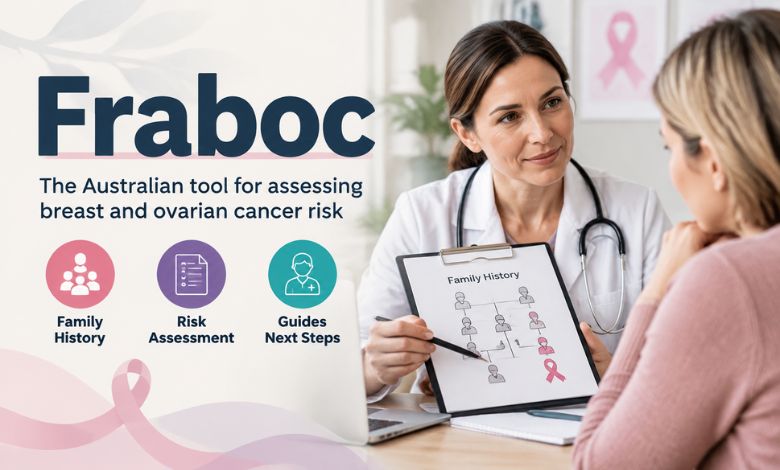
Fraboc was an Australian clinical tool created to help health professionals assess a woman’s risk of developing breast and ovarian cancer by examining her family history. The name referred to Familial Risk Assessment Breast and Ovarian Cancer, and the tool was designed to make family-history assessment more structured and easier to use in clinical settings.
Rather than diagnosing cancer, Fraboc helped health professionals look for patterns among relatives that might suggest an increased risk. Information such as which family members had cancer, what type of cancer they had, and the age at which they were diagnosed could all be important.
Although Fraboc is no longer available, the basic idea behind it remains relevant. Family history continues to play an important role in identifying people who may need a more detailed assessment for inherited cancer risk. Modern tools and clinical guidelines have developed since Fraboc was used, but understanding its purpose can still be useful when reading older Australian medical information.
What Was Fraboc?
Fraboc was developed as a family-history risk assessment tool for breast and ovarian cancer. It was intended primarily for health professionals rather than for people to use independently as a medical diagnosis tool.
The tool provided a structured way to review information about a woman’s relatives. This was useful because family cancer histories can quickly become complicated. A person may know that a mother, aunt, sister or grandmother had cancer, but may not remember the exact diagnosis or age at which it occurred.
A structured assessment could help bring those details together.
The main purpose was to determine whether a family history appeared consistent with average risk, increased familial risk, or a pattern that could warrant further specialist attention.
This did not mean that Fraboc could predict whether a person would definitely develop cancer. Risk assessment and diagnosis are two very different things.
Why Was Fraboc Important?
The importance of Fraboc came from a simple medical principle: family history can provide clues about cancer risk.
Most cancers are not caused by a single inherited gene change. However, some families have patterns of breast, ovarian and related cancers that may suggest an inherited predisposition.
For example, several close relatives developing breast cancer, particularly at relatively young ages, may be more significant than one distant relative developing the disease later in life. A family history that includes both breast and ovarian cancer can also attract greater clinical attention.
Fraboc helped health professionals examine these patterns in a consistent way.
This was especially useful in general practice, where doctors and other healthcare workers may be the first people to hear about a patient’s family history. Recognising a potentially important pattern can help determine whether the patient should receive additional assessment or be referred to a specialist service.
How Did Fraboc Assess Cancer Risk?
The foundation of Fraboc was family history. The information entered into or considered through the assessment was used to help estimate the potential significance of the family’s cancer pattern.
Important details could include the relationship between the patient and affected relatives, the type of cancer diagnosed, and the age at diagnosis.
The difference between a first-degree and more distant relative can matter. A mother or sister with breast cancer represents a different family-history relationship from a distant cousin. The number of affected relatives can also influence how concerning a pattern appears.
Age is another important factor.
Cancer occurring at a younger age can sometimes raise more concern about an inherited susceptibility than the same cancer occurring much later in life. That is why health professionals often try to collect accurate information about when relatives were diagnosed.
The bigger picture matters more than a single detail.
Was Fraboc a Genetic Test?
No. Fraboc was not a genetic test.
This distinction is important because people searching for the term today may assume that it was a laboratory test used to identify gene mutations. It was not.
A risk assessment tool works by evaluating available information and helping a clinician decide whether additional investigation may be appropriate. Genetic testing, by contrast, examines a person’s DNA for specific inherited changes.
A family-history assessment may lead to a discussion about genetic counselling or testing, but it does not by itself confirm that someone carries a particular gene variant.
This means an old Fraboc assessment should not be interpreted as proof that a woman did or did not have a hereditary cancer mutation.
Why Family History Still Matters Today
Even though Fraboc has been discontinued, family history remains an important part of breast and ovarian cancer risk assessment.
Doctors may ask about parents, siblings, children, grandparents, aunts, uncles and other relatives. They may also ask what type of cancer each person had and approximately how old they were when diagnosed.
This information can sometimes reveal a pattern that deserves closer attention.
A strong family history does not automatically mean that cancer is inherited. Families share many things besides genes, including lifestyle factors and environments. Some cancers can also occur by chance in several members of the same family.
That is why family history should be interpreted carefully rather than used to make assumptions.
A healthcare professional can assess the complete picture and decide whether further testing or specialist advice is appropriate.
Why Is Fraboc No Longer Available?
Fraboc belonged to an earlier generation of clinical risk assessment tools. Medical practice changes as new research becomes available, and older tools may eventually be replaced by newer systems.
In Australia, breast cancer risk assessment has moved toward newer approaches, including iPrevent, which is designed to support personalised breast cancer risk assessment and prevention discussions.
The replacement of an older tool does not mean that the original concept was incorrect. Instead, it reflects the fact that risk assessment methods can become more detailed as research, technology and clinical knowledge improve.
This is common across healthcare.
Medical calculators, guidelines and decision-support systems are regularly reviewed and updated so that clinicians can use approaches that better reflect current evidence.
What Is iPrevent?
iPrevent is a newer Australian risk assessment and decision-support tool used in breast cancer risk management.
It is designed to help healthcare professionals and women discuss individual breast cancer risk and possible prevention or screening strategies.
Unlike relying only on a simple family-history review, modern risk assessment can consider several factors together.
Depending on the clinical situation, these may include family history, personal medical information and other established risk factors.
For someone researching Fraboc today, iPrevent is particularly relevant because it represents part of the more modern approach that followed the older FRA-BOC system.
The two tools should not necessarily be treated as identical. Clinical tools evolve, and newer systems may use different evidence, models and methods.
Can Family History Mean a Higher Cancer Risk?
Yes, in some situations.
A person may have a higher-than-average risk when there is a significant family pattern of breast or ovarian cancer. However, having a relative with cancer does not automatically mean that a person has a hereditary cancer syndrome.
The details matter.
Healthcare professionals may pay particular attention when several close relatives are affected, when cancer occurred at younger ages, or when certain combinations of cancers appear within the family.
A family history that includes ovarian cancer can be especially important when evaluating possible hereditary breast and ovarian cancer risk.
Still, only a proper clinical assessment can determine what the family history means for an individual.
What Should You Tell Your Doctor About Your Family History?
People often remember that a relative “had cancer” but may not know exactly what type it was. Whenever possible, more precise information is useful.
Try to find out the type of cancer, the affected relative’s relationship to you and their approximate age when they were diagnosed.
It can also help to know whether other relatives had similar cancers.
Even information that seems incomplete can be useful as a starting point. A doctor may ask additional questions or recommend obtaining medical records when necessary.
The purpose is not to create fear. It is to make sure that potentially important information is not overlooked.
Fraboc and Hereditary Cancer Assessment
One of the reasons Fraboc remains an interesting medical topic is its connection with the broader concept of hereditary cancer risk assessment.
Some inherited gene variants can increase the likelihood of certain cancers. Well-known examples include changes in the BRCA1 and BRCA2 genes, which are associated with increased risks of breast and ovarian cancer.
However, genes are only one part of the story.
A person’s overall cancer risk may be influenced by many different factors. Family history can help identify people who may benefit from genetic counselling, but it does not replace a complete clinical evaluation.
Modern cancer genetics services can use family history, personal history and, where appropriate, genetic testing to provide a more detailed assessment.
Why Old Medical Tools Can Still Be Relevant
It may seem unusual that people continue searching for a tool that is no longer available. However, older medical tools often appear in archived websites, research papers, healthcare documents and educational materials.
Someone may encounter Fraboc in an older Australian healthcare reference and want to understand what the term means.
Knowing that Fraboc was a former breast and ovarian cancer familial-risk assessment tool can make those documents much easier to understand.
It also helps prevent another common mistake: assuming that an old tool is still recommended for use today.
Medical information can become outdated, so it is always important to distinguish between a historical resource and current clinical guidance.
Fraboc Was Not a Cancer Diagnosis
Another important point is that Fraboc was about risk assessment, not cancer detection.
A risk assessment cannot tell someone that they currently have breast cancer or ovarian cancer. Symptoms, screening results, examinations and diagnostic tests are used for those purposes.
Likewise, a person’s risk category does not guarantee what will happen in the future.
Someone considered at higher risk may never develop cancer, while someone without an obvious family history can still develop cancer.
Risk estimates are useful because they help guide decisions, but they are not predictions with certainty.
How Modern Risk Assessment Has Changed
Cancer-risk assessment has become more personalised over time.
Instead of depending on one family-history tool, healthcare professionals can now use several sources of information to understand an individual’s situation.
This may include detailed family history, personal health information, genetic counselling and validated risk models.
The development of newer tools such as iPrevent reflects this broader approach.
The goal remains similar to the goal that made Fraboc useful in the first place: identify people who may have a meaningful increase in cancer risk and make sure they receive appropriate information and care.
The difference is that modern systems can offer more detailed and updated ways of supporting that process.
Should You Look for the Old Fraboc Tool Online?
There is generally little benefit in trying to use an archived version of an old clinical tool to calculate your current cancer risk.
Because medical guidance and assessment methods can change, an old result may not accurately reflect current recommendations.
Someone with concerns about their family history should speak with a doctor, genetic counsellor or appropriate specialist service rather than relying on an outdated calculator.
The information found in older resources can still be useful for understanding history, but it should not replace modern professional assessment.
Conclusion
Fraboc was an Australian clinical tool developed to help health professionals understand a woman’s risk of breast and ovarian cancer by looking closely at her family history. It offered a structured approach at a time when assessing familial cancer risk was becoming increasingly important in everyday healthcare.
Although the tool is no longer available, the principle behind it has not disappeared. Family history is still an important part of evaluating possible hereditary cancer risk, and modern tools now provide more updated ways to support that process.
For anyone who comes across the term Fraboc in an older healthcare document, the simplest explanation is that it was a former familial breast and ovarian cancer risk assessment tool, not a genetic test and not a cancer diagnosis.
Today, people concerned about their family history should rely on current medical guidance and professional assessment rather than attempting to recreate an outdated tool. As cancer research continues to develop, risk assessment will likely become even more personalised, helping clinicians and patients make better-informed decisions about screening, prevention and genetic evaluation.
(FAQs)
What does Fraboc stand for?
Fraboc refers to Familial Risk Assessment Breast and Ovarian Cancer, an Australian clinical tool that was designed to help health professionals assess familial breast and ovarian cancer risk.
Is Fraboc still available?
No. The original Fraboc tool has been discontinued and is no longer available as the current Australian risk assessment resource it once was.
Was Fraboc used to diagnose cancer?
No. Fraboc was a risk assessment tool, not a diagnostic test. It helped clinicians evaluate family-history patterns that could indicate increased cancer risk.
What replaced Fraboc?
Modern Australian practice uses newer approaches to cancer-risk assessment. iPrevent is one important tool used for breast cancer risk assessment and prevention discussions. Specialist genetic services may also use other validated methods depending on the individual situation.
Does having breast or ovarian cancer in my family mean I will get cancer?
Not necessarily. A family history can increase risk in some circumstances, but it does not mean that cancer is certain. The number of affected relatives, their relationship to you, cancer type and age at diagnosis can all influence the overall assessment.